Cloud Kitchen Malaysia: Costs, Orders, and Profitability in 2026
Margins disappear fast in Malaysia's cloud kitchen market. Before you sign a pod, list on GrabFood, or chase order volume, understand the real costs, the actual order flow, and the compliance traps that can quietly undermine profitability. This guide breaks down the numbers, operations, and systems that help cloud kitchens stay in control.
 29 May 2026

 Eats365
Contents
- What a Cloud Kitchen in Malaysia Actually Costs Per Month
- The Step-by-Step Order Flow for a Malaysian Cloud Kitchen
- Compliance Requirements for Cloud Kitchens in Malaysia
- Is a Cloud Kitchen in Malaysia Profitable
- How Eats365 Solves the Biggest Cloud Kitchen Pain Points in Malaysia
- Checklist to Start a Cloud Kitchen in Malaysia
- The Bottom Line on Cloud Kitchens in Malaysia
- FAQs about Cloud Kitchen Malaysia
What a Cloud Kitchen in Malaysia Actually Costs Per Month
The most common reason Malaysian cloud kitchen ventures fail is not a bad menu — it is a cost structure that was never stress-tested against real platform economics. Before signing a pod rental agreement or listing on a delivery platform, you need to understand every recurring cost layer.
| Cost Category | Typical Range (RM/month) | Notes |
|---|---|---|
|
Shared pod rental (KL/PJ) |
RM 2,000 – RM 6,000 |
|
|
Platform commissions (GrabFood / Foodpanda / ShopeeFood) |
25–35% per order per platform |
|
|
Ingredient COGS (delivery-optimised menu) |
28–38% of revenue |
|
|
Packaging materials |
RM 800 – RM 2,500 |
|
|
Staff (2–3 kitchen crew) |
RM 4,500 – RM 9,000 |
|
|
POS system and delivery tech |
RM 200 – RM 600 |
|
|
Utilities (electricity, water, gas) |
Often included in pod rental; if self-operated: RM 1,500 – RM 3,000 |
|
|
Marketing (in-app ads, promoted listings) |
RM 500 – RM 2,000 |
|
|
Estimated Total Monthly Burn |
RM 12,000 – RM 28,000+ |
Before factoring commission deductions from revenue. |
Why Commission Stacking Is the Core Profitability Risk
Many operators treat platform commission as a simple percentage off revenue. In practice, the hit is more severe.
Here is what actually happens:
-
GrabFood, Foodpanda, and ShopeeFood each deduct commission from their own orders separately
-
There is no automatic blended rate across platforms
-
There is no single payout view that shows true net revenue unless your POS calculates it
Consider a cloud kitchen doing RM 60,000 in monthly delivery GMV across three platforms:
-
At a 30% blended commission, RM 18,000 goes to platforms first
-
That leaves RM 42,000 before ingredient costs
-
At 33% COGS, another roughly RM 14,000 is consumed
-
You are left with about RM 28,000 to cover rent, staff, packaging, marketing, POS, and profit
The Step-by-Step Order Flow for a Malaysian Cloud Kitchen
Understanding the mechanics of order flow is the single most important operational discipline in cloud kitchen management. Every breakdown in this sequence costs you money, reputation, or both.
Step 1 — Order Received on Aggregator Platform
A customer places an order via GrabFood, Foodpanda, or ShopeeFood. The platform confirms the order and starts the preparation countdown timer, which is typically displayed to the customer.
Step 2 — Order Auto-Accepted into Centralized POS Dashboard
With Eats365's delivery integration, orders from GrabFood, Foodpanda, and ShopeeFood are automatically pulled into a single Eats365 POS dashboard. There is no need for kitchen staff to manually monitor three separate tablets or toggle between three merchant apps. All incoming orders — regardless of platform — appear in one consolidated queue, colour-coded by platform and sorted by preparation priority.
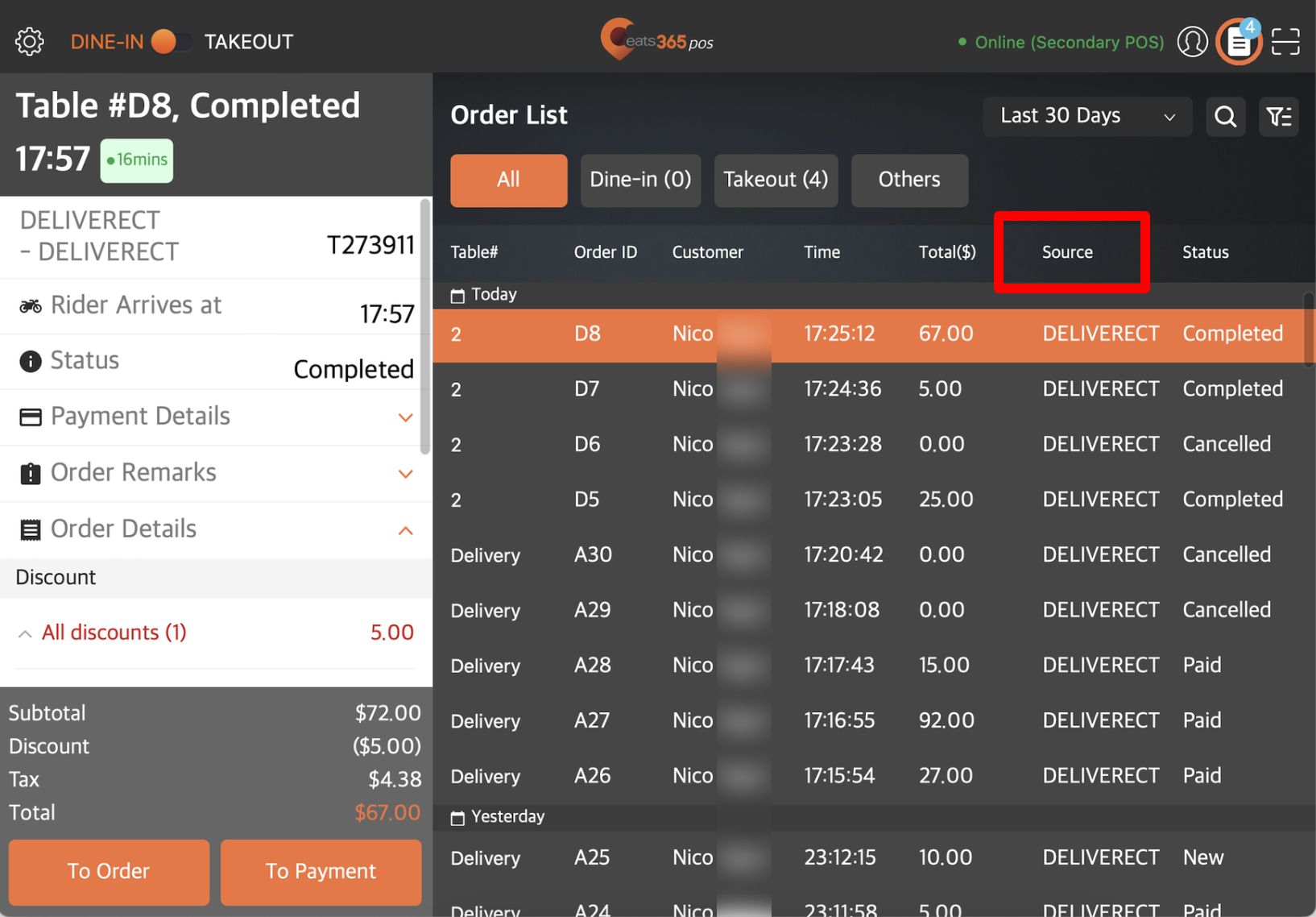
Read more: Manage orders from Delivery Integrations - Eats365 (eats365pos.com)
Step 3 — Automatic KDS Ticket Routing
The moment an order is accepted into the Eats365 POS system, the Eats365 Kitchen Display System (KDS) generates a kitchen ticket and routes it to the correct station. In a multi-brand cloud kitchen setup — for example, one pod running a nasi lemak brand and a western bowl brand simultaneously — the KDS routes items to the appropriate cooking station without manual re-entry. This eliminates the most common source of peak-hour errors: a kitchen crew member missing an order on a separate platform tablet.
KDS display highlights:
-
Order source
-
Items and modifiers
-
Preparation countdown
-
Station queue sequence
-
Completion status
Step 4 — Kitchen Preparation with Countdown Visibility
Cooks work against the KDS timer display. Eats365 KDS shows preparation status in real time, allowing the packing station to anticipate when an order will be ready for boxing rather than waiting for a shout across the kitchen.
Step 5 — Packaging SOP Execution
Once cooking is complete, the packing station receives the KDS completion signal. The packer matches items to the order ticket, applies tamper-evident seals, attaches a printed order label (generated by the Eats365 POS receipt printer), and places the order in the designated collection zone by platform.
Separating collection zones by platform — GrabFood orders on the left shelf, Foodpanda in the centre, ShopeeFood on the right — is a simple but critical SOP that prevents wrong-order handoffs during busy periods.
Step 6 — Rider Arrival and Handoff
The POS dashboard displays the estimated rider arrival time pulled from the platform's API. When the rider scans or confirms the order, staff complete the handoff. The order is marked as dispatched in the centralized dashboard, and the transaction data — including platform source, order value, and timestamp — is logged for per-platform reporting.
Step 7 — Per-Platform Revenue Reconciliation
At end-of-day or end-of-week, the Eats365 POS reporting module generates a breakdown of total orders, gross revenue, and — critically — an estimate of post-commission net revenue by platform. This is the data layer that tells you whether ShopeeFood's lower commission rate is actually outperforming GrabFood's higher volume, or vice versa, once the math is done.
Read more: View and manage Reconciliation Report - Eats365 (eats365pos.com)
Compliance Requirements for Cloud Kitchens in Malaysia
Compliance for cloud kitchens in Malaysia is more nuanced than for a standard dine-in restaurant, primarily because the non-shopfront nature of the operation creates ambiguity with local councils and because the Muslim-majority market makes JAKIM Halal certification a near-mandatory commercial reality — not a nice-to-have.
Licensing Checklist
| Requirement | Issuing Body | Cloud Kitchen Specifics |
|---|---|---|
| SSM Business Registration | Suruhanjaya Syarikat Malaysia (SSM) | Required for all business entities, including Sdn. Bhd. and sole proprietorships operating a cloud kitchen. |
| Business Premise License | Local council (DBKL for KL; MBPJ for Petaling Jaya; MBSA for Shah Alam, etc.) | Required even for non-shopfront kitchens. If you operate within a shared cloud kitchen facility, the facility may hold the premise license — verify this explicitly with your pod operator before signing. If you operate a standalone delivery-only kitchen unit, you must apply independently. |
| Food Handling Certification | Ministry of Health (MOH) | All food handlers must complete an MOH-approved food handler training course before commencing operations. Non-compliance is a common ground for enforcement action under the Food Hygiene Regulations 2009. |
| Food Act 1983 Compliance | Ministry of Health | Even without a shopfront, delivery kitchens are subject to Food Act 1983 enforcement. MOH inspections cover refrigeration standards, raw-cooked food separation, grease trap installation, pest control documentation, and waste disposal. Fines and closure orders apply to non-compliant operators regardless of whether customers visit the premises. |
| JAKIM Halal Certification | JAKIM (Jabatan Kemajuan Islam Malaysia) | See note below. |
| OKU-owned business concessions (premise/hawker license fees) | Local council (DBKL/MBPJ/MBSA, etc.) | Some local councils may offer fee reductions, concessions, or faster processing for registered OKU (Orang Kurang Upaya) business owners. These concessions do not waive compliance with the Food Act 1983 or Food Hygiene Regulations 2009, and they do not remove site inspection requirements. For brands operating inside shared cloud kitchen facilities, eligibility may differ depending on whether the facility or the individual pod/brand is the actual licence holder, so get written confirmation from both the facility and the relevant PBT. |
| Signboard License | Local council | Required only if external signage is displayed — most pure cloud kitchens operating within shared facilities do not need this, but verify with your local PBT. |
OKU Licensing Quirks
-
Confirm OKU eligibility and any applicable concessions directly with the licensing unit of your local PBT, such as DBKL, MBPJ, or MBSA.
-
Prepare supporting documents early: JKM OKU registration/card, SSM registration documents, and your tenancy or pod sublease agreement.
-
Clarify whether any concession applies to the facility licence holder, the individual brand, or the specific pod unit.
-
Get the council to confirm in writing which items may be reduced or expedited, and which obligations remain non-negotiable, especially hygiene compliance and inspections. Where relevant, record council-specific conditions in your tenancy agreement.
-
Keep written records of all correspondence with the council and facility operator.
Policies can vary by municipality, so do not generalise across councils — always obtain written confirmation from the PBT that governs your kitchen location.
Is a Cloud Kitchen in Malaysia Profitable
Yes, a cloud kitchen in Malaysia can be profitable, but only when the numbers work at both startup and daily operating level.
Cloud Kitchen Profitability Calculation
Cloud kitchen operators who assess profitability using gross delivery revenue are systematically overestimating their margins. The correct profitability unit of analysis is net revenue per order per platform, calculated as:
Net Revenue per Order = Order Value − Platform Commission − Ingredient COGS − Packaging Cost − Allocated Overhead per Order
A RM 35 nasi lemak set order on GrabFood at 30% commission yields RM 24.50 before food cost. At a 33% COGS ratio, ingredient cost is approximately RM 11.55. Packaging materials for a leakproof set meal with rice and gravy: approximately RM 1.50. That leaves RM 11.45 per order to cover pod rental, staff wages, marketing, POS fees, and net profit. At 300 GrabFood orders per month, that is approximately RM 3,435 in contribution margin from GrabFood alone — before you know whether Foodpanda and ShopeeFood orders are performing better or worse.
What Makes the Model Viable
Compared with a physical restaurant, a cloud kitchen usually needs less upfront capital because you are not paying for a dining area, front-of-house fit-out, furniture, or service staff. Your startup budget is generally focused on kitchen rent or pod rental, cooking equipment, licenses, food safety compliance, packaging setup, and onboarding to delivery platforms. That lower setup cost makes cloud kitchens attractive, but it does not automatically make them high-margin businesses.
Profit is mainly driven by three things: order volume, average order value, and menu pricing. If your kitchen receives enough daily orders, keeps ticket size healthy, and prices items properly for delivery, the model can work. But if order volume is inconsistent or your menu is underpriced, platform commissions and operating costs will erode margins quickly.
Cloud kitchens tend to work best for delivery-first brands, operators with strong digital demand, and menus that travel well and stay profitable after packaging and platform fees. They are especially suited to niche concepts, single-product specialists, and multi-brand operators who can use one kitchen efficiently across several delivery-only menus.
Where Profitability Breaks Down
The biggest ongoing costs are usually:
-
Platform commissions from GrabFood, Foodpanda, and ShopeeFood
-
Ingredients and beverage cost
-
Packaging materials
-
Labour for prep, cooking, and packing
-
Pod or kitchen rent
-
Utilities, if not included in rent
-
Marketing spend such as in-app ads and promotions
-
POS and delivery management software
A simple way to think about break-even is this: your kitchen must generate enough contribution margin per order to cover monthly fixed costs.
For example, if your monthly fixed operating cost is RM 18,000 and you retain about RM 12 after commission, food cost, and packaging on each order, you need roughly 1,500 orders per month to break even. That is about 50 orders per day. If your actual contribution per order is lower, your required daily order count goes up.

How Eats365 Solves the Biggest Cloud Kitchen Pain Points in Malaysia
The two problems that define cloud kitchen operations in Malaysia — fragmented order management and the inability to track per-platform margins — are both technology problems. They are solved by a unified POS system with native delivery aggregator integration and a kitchen display system built for multi-source order routing.
Pain Point 1: Fragmented Orders Across GrabFood, Foodpanda, and ShopeeFood
The problem: Orders arrive across three separate merchant interfaces. Kitchen staff toggle between tablets, miss notifications, and manually relay tickets to cooks. During peak hours, this architecture produces errors, delays, and bad reviews that compound into lower platform ranking.
The Eats365 solution: Eats365's Delivery Integration consolidates incoming orders from GrabFood, Foodpanda, and ShopeeFood into a single centralized dashboard. Orders are automatically accepted, queued by priority, and displayed in one interface — eliminating the need for multiple tablets. Menu updates (price changes, item 86s, new offerings) are pushed to all connected platforms from one Eats365 back-office entry, rather than requiring manual updates on each platform's merchant portal separately.

Read more: Sync menus for takeaway platform integrations - Eats365 (eats365pos.com)
Pain Point 2: No Visibility Into Post-Commission Profitability by Platform
The problem: At end of month, the operator receives separate payouts from each platform, each with different commission structures, promotional deductions, and adjustment credits. Reconciling these manually against kitchen costs is time-consuming and error-prone. Most operators cannot tell you whether GrabFood or Foodpanda was more profitable last month, net of commissions.
The Eats365 solution: Because every order entering the Eats365 POS system is tagged with its platform source, the reporting module can generate per-platform order count, gross revenue, and estimated net revenue after platform commissions. This data turns a guesswork business into a data-driven one: you know which platform deserves your in-app advertising spend, which platform's commission rate is eroding your margins most aggressively, and when you have crossed the order volume threshold that justifies negotiating a rate reduction.

Read more: View and manage Transaction Report - Eats365 (eats365pos.com)
KDS supports multi-source ticket routing and countdown visibility without requiring staff to manage separate order streams manually.
Checklist to Start a Cloud Kitchen in Malaysia
For F&B entrepreneurs moving from concept to launch, the sequence below is designed to prevent the most common and expensive setup mistakes — the ones that cause operators to burn rent while waiting for approvals, or to discover compliance gaps after they have already invested in equipment.
Phase 1 — Business Structure and Registration
-
Register with SSM as a sole proprietorship, partnership, or Sdn. Bhd. (Sdn. Bhd. is recommended if you plan to scale to multiple brands or seek investment)
-
Define your operating entity clearly — this matters for JAKIM Halal application and platform merchant agreements
Phase 2 — Premises and Facility Selection
-
Evaluate shared cloud kitchen facilities in your target delivery radius (Ara Damansara, Cheras, Desa Sri Hartamas, Bandar Sunway are active hubs)
-
Confirm whether the facility holds its own business premise license with the local PBT (DBKL, MBPJ, MBSA) or whether you need to apply independently
-
Confirm the facility's Halal certification status and whether individual brands require separate JAKIM certification
-
Verify that utility costs (electricity, gas, water) are included in the pod rental rate
Phase 3 — Compliance and Certification
-
Complete MOH food handler certification for all kitchen staff
-
Obtain your business premise license from the relevant local council if not covered by the facility
-
Begin JAKIM Halal certification process early — the process from application to audit typically takes several months
-
Ensure kitchen layout complies with Food Act 1983 and Food Hygiene Regulations 2009: separate raw/cooked handling areas, grease trap installation, pest control documentation
Phase 4 — Platform Onboarding and POS Setup
-
Register as a merchant on GrabFood (via GrabMerchant portal), Foodpanda (via Partner Hub), and ShopeeFood
-
Set up Eats365 POS with delivery integration configured for all three platforms
-
Connect Eats365 KDS to your kitchen stations
-
Configure per-platform commission rates in the Eats365 reporting module for accurate margin tracking
-
Build your delivery-optimised menu with target food cost ratios below 32% and item-level packaging specifications documented
Phase 5 — Operations Launch and Optimisation
-
Establish collection zone SOPs by platform (separate physical areas for GrabFood, Foodpanda, ShopeeFood orders)
-
Set a review cadence (weekly) to assess per-platform performance data from Eats365 reporting
-
Negotiate commission rates with platform account managers once you exceed 200 orders/month per platform
-
Adjust marketing spend (in-app promotions) based on which platforms show the strongest post-commission margin
The Bottom Line on Cloud Kitchens in Malaysia
A cloud kitchen in Malaysia can work — but only with tight control over margins, compliance, and order operations.
The strongest operators know their per-order economics, build for halal-market access, and use centralized POS reporting to track platform performance clearly. The weakest ones spread themselves across platforms without knowing which channel is actually profitable.
Eats365's delivery integration and KDS module are built for exactly this operating context. If you are planning to launch or scale a cloud kitchen in Malaysia and want to see how centralised order management and per-platform margin tracking work in practice, book a free Eats365 POS demo with the Malaysia team.
FAQs about Cloud Kitchen Malaysia
Q: What is a cloud kitchen in Malaysia?
A cloud kitchen (also called a ghost kitchen or dapur awan) is a delivery-only food production facility that prepares meals exclusively for orders placed through platforms like GrabFood, Foodpanda, and ShopeeFood, or through a brand's own website. There is no dine-in space or walk-in counter.
Q: How much does it cost to start a cloud kitchen in Malaysia?
Shared pod rental in KL typically ranges from RM 2,000 to RM 6,000 per month for an established, fully-equipped station. Total monthly operating costs — including staff, packaging, platform commissions, marketing, and POS — commonly range from RM 12,000 to RM 28,000 depending on volume and location. Initial setup costs are significantly lower than a brick-and-mortar restaurant, with some shared facility operators enabling launches for under RM 30,000 in upfront capital.
Q: What licenses do I need to open a cloud kitchen in Malaysia?
You need SSM business registration, a business premise license from your local council (DBKL, MBPJ, or equivalent), MOH food handler certification for all kitchen staff, and compliance with the Food Act 1983 and Food Hygiene Regulations 2009. JAKIM Halal certification is not legally mandated but is a near-mandatory commercial requirement to access Malaysia's majority Muslim delivery market.
Q: Is JAKIM Halal certification required for a cloud kitchen in Malaysia?
Not legally mandatory, but commercially essential. GrabFood and Foodpanda both include Halal filters in their consumer search interfaces. Operating without Halal certification effectively makes your listing invisible to the majority of Malaysian delivery app users. Budget RM 10,000–12,000 and several months of lead time for the certification process.
Q: How do I manage orders from GrabFood, Foodpanda, and ShopeeFood at the same time?
The most operationally efficient approach is to use a POS system with native multi-aggregator integration — such as Eats365 POS — that consolidates orders from all three platforms into a single dashboard and automatically routes kitchen tickets through a connected KDS. Running three separate merchant tablets without a centralized system is a common source of order errors, missed notifications, and peak-hour chaos.
Q: Is a cloud kitchen in Malaysia still profitable after platform commissions?
Yes — but only if you are tracking per-platform post-commission margins, not total revenue. With a blended commission rate of 25–35% and food costs of 28–35%, profitability depends on menu engineering, order volume per platform, and operational efficiency. Operators who cannot see which platform generates the best post-commission margin per order are typically over-spending on the wrong platforms and under-investing in their most profitable channel.