Paper Menu, QR Ordering vs NFC: Which is the Best Application for Restaurants in Malaysia
Did you know paper menus can quietly increase your restaurant's food costs by 5–7%? In Malaysia's competitive F&B scene, optimizing operations matters. This article explains why traditional menus become financial drains and looks at whether QR Ordering (scan-to-order) or NFC is the better digital solution to improve your profits and efficiency.
 27 Nov 2025

 Eats365
Contents
- Your menu costs more than you think — what hidden drains are killing profits
- QR Ordering Dominates Malaysian Self-Ordering — Why NFC Isn't the Ordering Solution You Think
- Two Proven Moves to Adopt Digital Menus Successfully
- Elevate Your Restaurant’s Efficiency Today
- FAQs on Digital Menu Transition for Malaysian Restaurants
Your menu costs more than you think — what hidden drains are killing profits?
Hidden costs from paper menus—including reprinting, order errors, and manual reconciliation—silently drain 5–7% of food costs annually for Malaysian restaurants.
Many Malaysian restaurants treat the menu cost as the price from the printer and stop there. That picture misses a lot. Beyond printing, hidden drains — labor for updates, customer order errors, and reconciliation errors in manual order and payment processing — can quietly shave off 5–7% of your food costs each year. Not dramatic enough to trigger alarms, but steady enough to matter.
Take reprints. Ingredient prices in Malaysia move frequently. When a supplier raises the price of chicken or cooking oil, someone needs to update spreadsheets, redesign layouts, coordinate with the printer, and replace every menu in the restaurant. Those hours add up. Staff time spent on these tasks could be used on service, training, or marketing instead. It’s a recurring operational drag that slowly chips away at margins.
Outdated menus also cause friction between front and back of house. Picture a busy Saturday: a waiter takes an order for a popular dish only to find the kitchen ran out an hour earlier because the menu still listed it. The result is disappointed customers, extra food waste from incorrect prep, and often comped items or refunds. Those immediate costs are one thing—damage to your reputation is another and harder to fix.
Reconciliation errors in manual order and payment processing create significant hidden costs. Staff spend hours matching cash, card transactions, and paper order tickets at shift end—a process prone to human error. A single missed item rings up as lost revenue, while unrecorded payments create cash flow gaps. These discrepancies accumulate silently, contributing to that 5–7% loss. For instance, a mid-sized restaurant in Petaling Jaya found RM1,200 monthly leakage from manual reconciliation gaps during a 3-month audit. Digital POS systems eliminate this by syncing orders and payments automatically, freeing staff for higher-value tasks while ensuring financial accuracy.
QR Ordering Dominates Malaysian Self-Ordering — Why NFC Isn't the Ordering Solution You Think
While NFC is gaining traction for contactless payments in Malaysia, QR code-based scan-to-order remains the dominant self-ordering method for restaurants. Many establishments mistakenly believe NFC is the next big thing for ordering, but it has significant limitations as an ordering tool. Here’s why QR Ordering is still king and why NFC is better suited for payments.
Why NFC Falls Short for Ordering
NFC requires customers to have NFC-enabled smartphones and know how to activate the feature—a hurdle for older devices common among Malaysia’s 40+ age group (which constitutes 35% of dine-in customers per Department of Statistics Malaysia). More critically, NFC ordering often demands a dedicated app download, creating friction. In contrast, QR codes work universally with any smartphone camera and redirect to mobile-friendly menus instantly—no app needed. This simplicity explains why 92% of Malaysian restaurants using self-ordering opt for QR, as reported in .
Additionally, cost and setup realities further hinder NFC adoption for ordering. QR setup involves minimal cost: a free generator and standard printing. NFC ordering requires purchasing tags, dedicated Readers, and POS integration—increasing complexity. For Malaysian restaurants, especially SMEs operating on thin margins, QR is the practical choice for ordering. Reserve NFC for its true strength: payment speed.
The Real Power of NFC: Payments
Where NFC shines is in contactless payments. Once orders are placed via QR scan, NFC allows customers to tap and pay in under 3 seconds—critical in high-rent areas like Kuala Lumpur where table turnover directly impacts revenue. Maybank’s 2024 analysis shows NFC payments reduce checkout time by 68% compared to cash, but this benefit applies only to payment—not ordering. This speed is critical in high-rent areas like Kuala Lumpur where faster table turnover during peak hours directly increases revenue potential.
Why QR Ordering Reigns in Malaysia
QR ordering dominates in Malaysia for four key reasons:
-
Cost Efficiency: QR codes cost almost nothing to generate and print, while NFC requires tags and readers (RM 50-100 per table).
-
Universal Accessibility: Works on any smartphone camera without app downloads; NFC requires newer phones and app setup.
-
Proven Adoption: Malaysians are familiar with QR through DuitNow and e-wallets, leading to 78% customer usage at Kopitiam 365 within a month.
-
Operational Simplicity: Integrates with existing POS systems without major hardware changes, avoiding the RM 2,000+ upfront cost NFC demands for SMEs.
Case in point: Kopitiam 365 in Penang cut ordering time by 30% after switching to QR menus, with 78% of customers using digital menus within a month—without new hardware. NFC ordering would have required RM2,000+ for tags and Readers across 40 tables, a prohibitive cost for SMEs.
Two Proven Moves to Adopt Digital Menus Successfully
Successful digital menu adoption requires phased rollouts and training staff as tech guides to ensure smooth transitions without alienating regulars.
Move 1: Implement a Phased Rollout to Minimize Disruption
Start with a limited scope: use digital menus for a specific category like weekend specials or new promotions. This low-risk approach gives customers a frictionless entry point. For example, Nasi Lemak Corner in Selangor introduced QR codes only for their premium seafood additions. Within three weeks, 60% of customers used the digital menu for these items, with servers noting "no complaints" during the trial phase. Gradually expand to drinks, then appetizers, and finally the full menu—monitoring adoption rates at each stage. A 2024 F&B Tech Survey revealed restaurants using phased rollouts saw 45% fewer customer complaints than those switching abruptly. Crucially, maintain printed menus for legacy items during transition; this dual approach at Cafe Biji Kota Kinabalu retained 95% of regulars while achieving 70% digital adoption in 8 weeks.
Move 2: Transform Staff into Patient Tech Guides to Ease Customer Transition
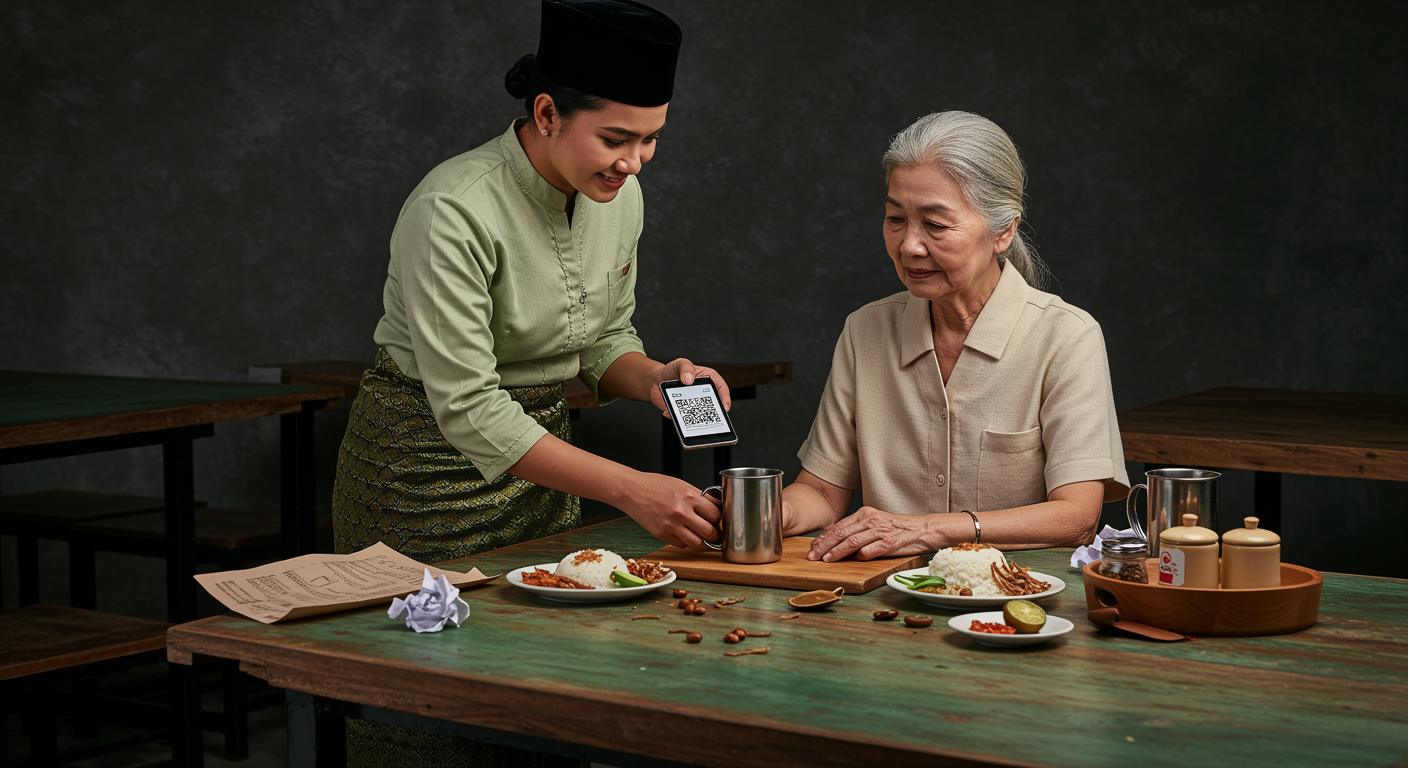
Customers can feel frustrated when a beloved restaurant switches to digital menus. Elderly patrons might struggle with scanning QR codes, while others may worry about phone battery life or simply prefer the tactile experience of a paper menu. To prevent this from turning away loyal customers, train your staff to become patient tech guides.
Implement a two-week pre-shift training program (just 20 minutes per session) where servers practice scanning QR codes on demo tablets. Teach them to recognize customer hesitation—like a diner fumbling with their phone or looking confused—and step in with a friendly offer: "Boleh saya tunjukkan cara mudah pesan?" ("May I show you the easy ordering method?").
At Mamak Spot KL, staff turned this interaction into a service upgrade: while helping customers navigate the QR menu, they made personalized recommendations such as "Saya sarankan minuman ini, sangat segar!" ("I recommend this drink—it's very refreshing!"), which increased average check sizes by 15%. Crucially, always keep printed menus available. If a customer declines digital ordering, respond warmly: "Tidak mengapa, saya bawa menu kertas untuk anda" ("No problem, I'll bring you a paper menu"). This flexibility at Restoran Sambal Hijau prevented any customer walkouts during their transition.
Also, ensure your digital platform integrates directly with your POS. This eliminates manual order entry errors that lead to delays and disputes—reducing customer frustration by up to 31% as seen at The Social Shop. The goal is a seamless experience where technology supports, not disrupts, great service.
Elevate Your Restaurant’s Efficiency Today
For Malaysian restaurateurs facing a competitive F&B market, digital change matters. Eats365's integrated restaurant POS system with features like QR code ordering and seamless payment processing can cut the hidden costs tied to paper menus, streamline operations, and improve customer experience. If you’re curious how this could work for your outlet, send us an inquiry today to see how Eats365 can support your growth.
FAQs on Digital Menu Transition for Malaysian Restaurants
Q: What are the top benefits of switching from paper menus to NFC-enabled digital ordering?
NFC is not recommended as the primary method for digital ordering in Malaysia due to hardware costs and smartphone compatibility issues. For payments, NFC offers speed (3-second transactions) and hygiene. For ordering, QR-based systems deliver the real benefits: eliminating printing costs, enabling real-time updates, reducing order errors, and generating customer preference data—without NFC's hardware barriers.
Q: How are restaurants in Malaysia reducing paper menu costs with digital technology?
Many Malaysian restaurants adopt QR-based digital menus to eliminate frequent reprints caused by price changes or menu tweaks. That saves money and staff hours. Digital menus also help meet environmental goals such as Malaysia’s push towards zero single-use plastics by cutting down on laminated menu waste. For example, The Social Shop reported a 90% reduction in printing costs and a 31% drop in order disputes after switching to QR ordering.
Q: How does NFC ordering work in restaurants and what equipment do I need?
NFC ordering involves placing NFC tags on tables; customers tap with a compatible phone to open a digital menu. However, as explained in the article, this method is hindered by smartphone compatibility and app requirements. Equipment needed: NFC tags (RM1-5 each), readers (RM50-100 per station), and NFC-enabled POS. Due to high costs and low adoption, QR ordering is the preferred alternative in Malaysia.
Q: What are the hidden costs of maintaining paper menus in a restaurant?
Hidden costs extend far beyond printing. They include labor for frequent updates and reprints, mistakes from outdated menus that lead to food waste, and reputational damage from order disputes. There are also environmental compliance pressures, since laminated menus contribute to plastic waste. These hidden drains can quietly erode 5–7% of a restaurant’s food costs annually, making digital options a more cost-effective and sustainable choice.
Q: How can Eats365 help my restaurant transition from paper menus to digital ordering?
Eats365 provides an integrated POS platform that supports QR code ordering (the dominant method in Malaysia) and NFC contactless payments, along with real-time menu updates and direct kitchen order flow. We help you plan a phased rollout, train staff as tech guides, and integrate reporting and loyalty features to minimize errors, speed up service, and use analytics to improve menu performance.