Riding the Ghost Kitchen Trend 2026
Want to launch a restaurant for just $30K instead of $1M? Ghost kitchens are the 2026 secret for delivery-only success. Cut rent, skip front-of-house staff, and escape "tablet hell" with integrated tech. Discover how virtual brands and kitchen pods are reshaping F&B profitability today.
 23 Feb 2026

 Eats365
Contents
What Is a Modern Ghost Kitchen?
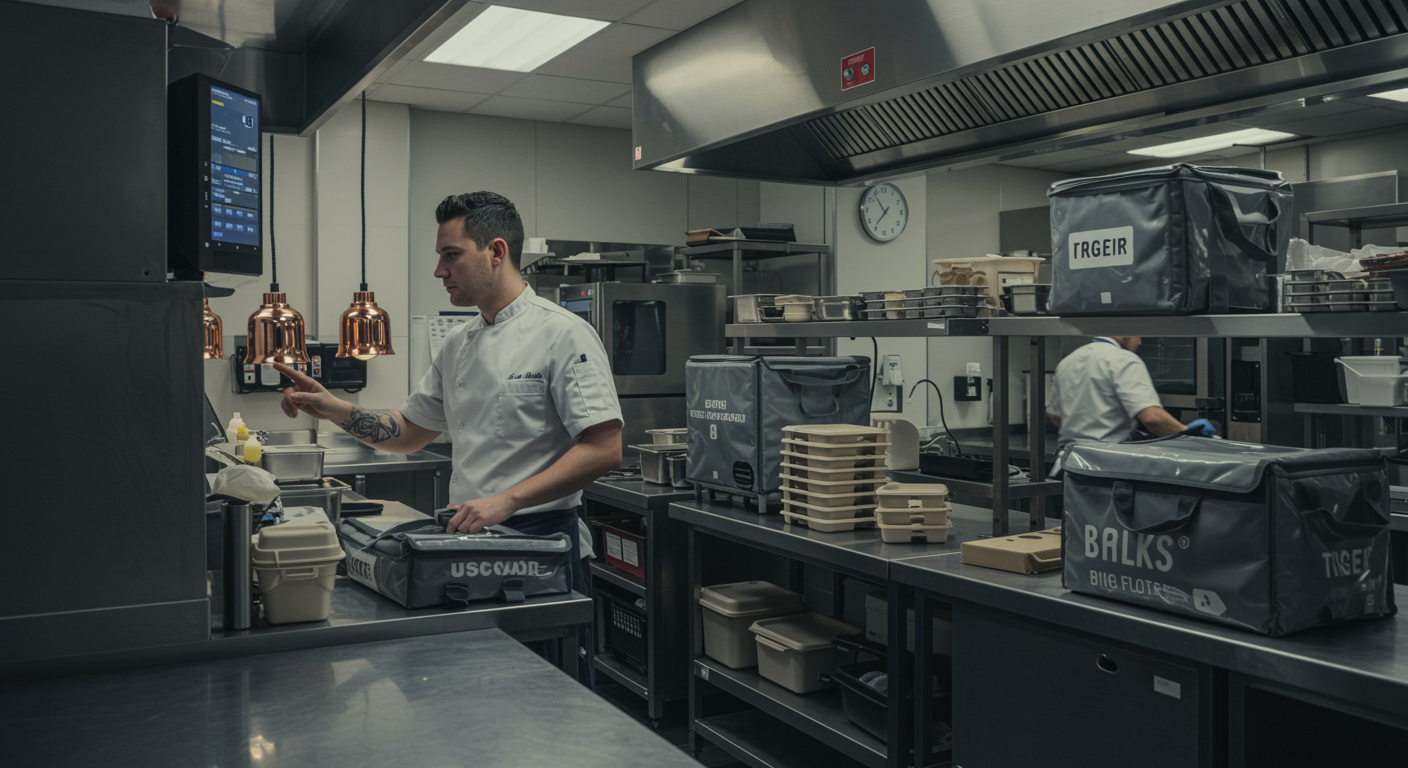
A ghost kitchen, also called a dark or cloud kitchen, is a commercial cooking facility built only for delivery and takeout. Unlike traditional restaurants, ghost kitchens remove the dining room, front-of-house staff, and prime retail rent. Orders arrive through third-party delivery platforms like DoorDash, Uber Eats, and Grubhub, as well as direct online channels. Staff prepare food, package it, and hand it to delivery drivers—simple and focused. This model tackles the main challenge facing restaurant operators in 2026: how to meet growing delivery demand without the capital burden of traditional buildouts.
The numbers are plain to see. Starting a ghost kitchen costs significantly less than traditional restaurants, with CloudKitchens reporting average capital investment of $30,000 and break-even within six months. That contrasts with traditional launches, which average $1 million in capital and can take up to five years to break even. The math is straightforward: no front-of-house labor, no prime retail rent, no heavy buildout—just production-focused infrastructure near delivery demand.
Emerging Ghost Kitchen Models for 2026 and Beyond
The American restaurant industry is shifting from traditional brick-and-mortar models toward delivery-optimized operations. What started as a pandemic necessity has become permanent consumer behavior, with the US parcel market projected to grow 36% by 2030 and food delivery volumes rising alongside it. The global ghost kitchen market, valued at $97.20 billion in 2025, is forecast to reach $204.33 billion by 2030 at a 16.0% compound annual growth rate. This rapid growth reflects a realignment in how Americans source meals—one that opens clear opportunities for operators willing to adapt.
The 40% acceleration in average delivery times from 6.6 days in early 2020 to 4.2 days by mid-2023 shows how far delivery infrastructure has come. But consumer priorities have shifted. Ninety percent of US consumers now prioritize delivery reliability over speed, and more than 90% say they’ll wait two or three days to avoid shipping costs. That’s a meaningful change: the rush for same-day delivery is easing, while predictability and cost control are rising in importance.
For ghost kitchen operators, this matters. Speed is still necessary, but the real edge comes from operational reliability, order accuracy, and tight cost control. About 45% of professional kitchens are expected to adopt AI tools by 2025, which can help with inventory forecasting and demand planning to avoid the costly mistakes of manual systems. Operators who build processes around consistency—rather than constant emergency speed-ups—are more likely to hold margins and keep customers coming back.
Ghost kitchens are not one-size-fits-all. Three models stand out, each fitting different operator needs and markets.
-
Shared Commissary Kitchens. These are professional facilities that rent space to multiple food businesses. The global shared kitchen market is projected to grow 16.7% annually until 2033, appealing to operators who want to limit capital outlay while getting proper licensing and compliance support. Commissary kitchens typically provide 200–300 square feet of dedicated space, integrated technology, and on-site staff support, so entrepreneurs can launch in weeks instead of months. The trade-off is monthly rent; the benefit is a professional setup without building from scratch.
-
Virtual Restaurant Brands from Existing Kitchens. Virtual brands—online-only concepts run from existing brick-and-mortar kitchens—let established restaurants capture extra revenue with little added cost. A full-service spot running at 75% kitchen capacity can introduce a delivery-only brand with shared ingredients and cross-trained staff. DoorDash reported in May 2024 that 70% of US consumers had ordered delivery in the past month, so the demand is mainstream. Operators who execute well report earning $5,000 to $20,000 in extra monthly revenue without adding fixed labor—a meaningful lift when margins run 3% to 5%.
-
Kitchen Pods and Mobile Units. Kitchen pods—modular cooking units deployed in parking lots, garages, or other non-traditional spaces—are the latest frontier. They lower real estate barriers and let operators test markets quickly. This model appeals to operators who want flexibility and the ability to try concepts in multiple cities without long-term leases.
The Ghost Kitchen 2026–2030 Outlook
Integrated Technology and AI
Integration is the core of ghost kitchen operations. Operational fragmentation across multiple delivery platforms is the top cause of inefficiency for scaling delivery brands. Kitchen staff juggling separate tablets for Uber Eats, DoorDash, and Grubhub suffer what industry folks call "tablet hell." Different alert systems and ticket formats force staff to switch context repeatedly, and that friction eats accuracy and speed.
Order aggregation systems consolidate incoming orders into a single dashboard, routing them to kitchen display systems without manual steps. Restaurants using unified systems report lower error rates and faster responses during peaks. The monthly cost—often a few hundred dollars—usually pays back through fewer refunds, fewer re-fires, and less labor spent managing devices.
Beyond orders, AI-driven inventory tracking and demand forecasting are becoming standard. AI tools help ghost kitchens reduce food waste and keep stock levels optimal with real-time monitoring and predictive restocking, which protects margins. For operators running multiple virtual brands from one facility, integrated inventory systems that track which ingredients feed which brand are essential for fair cost allocation and accurate profitability analysis.
Automation and Robotics
First, automation and robotics will become more accessible. The global kitchen robotics and automation market is projected to reach USD 8.63 billion by 2032, driven by labor shortages and the economics of repetitive, high-volume tasks. Devices like burger-flipping machines, automated pizza makers, and robotic sous-vide systems are shifting from novelty to useful tools. For ghost kitchens with thin margins, automating prep and portion control can be a real cost-saver.
Hybrid "Host Kitchen" Models
Second, hybrid "host kitchen" models—where restaurants rent unused kitchen time to delivery brands—are normalizing. Instead of fighting for ghost kitchen real estate, established operators can monetize idle capacity. Franklin Junction, a pioneer of the host kitchen idea, predicts that by 2025 more than 50% of restaurants will run multiple brands, and by decade’s end that could reach 90%. That points to a shift from single-concept restaurants toward multi-brand production hubs.
Looking ahead, delivery demand appears structural and growing, consumer expectations have shifted toward predictability, technology platforms can handle complexity, and hybrid models are becoming common. The ghost kitchen model has moved beyond a pandemic experiment to become a baseline option for how American restaurants compete.
Why Traditional Expansion Fails & How to Solve
-
Lower Startup Capital: Traditional expansion ties up significant capital, with many US full-service restaurants reporting opening costs from $300,000 to over $1,000,000 in busy urban areas. Industry guides show that starting a ghost kitchen typically requires only $20,000 to $60,000 (up to $100,000), as operators skip dining furniture, décor, and high-street rent.
-
Flexibility and Lower Risk: Traditional builds lock operators into long leases, high utilities, and large front-of-house teams, making it difficult to test new menus. Ghost kitchens, often located in cheaper industrial areas, eliminate front-of-house labor and use smaller, flexible crews, allowing operators to change cuisine or pricing quickly when data shows new demand without expensive renovations.
-
Unified Operations: Scaling across multiple delivery apps often leads to "tablet hell" and missed tickets when staff must juggle devices. POS middleware tools and integration platforms consolidate orders from DoorDash, Uber Eats, and Grubhub into one system. When served by cloud-based POS platforms like Eats365, the kitchen operates from a single KDS screen, reducing manual re-entry errors and improving speed.
-
Centralized Menu Management: Fragmentation occurs when each delivery platform runs its own menu file, leading to pricing drift and confusion. Centralized tools, such as Deliverect menu integrations and multi-channel POS menus, allow operators to push one source of truth to all channels. This ensures branding consistency and allows sold-out dishes to be paused everywhere in a few clicks, reducing cancellations.
-
Data-Driven Profitability: To scale profitably, operators need to know which orders actually drive profit. Unified reporting that combines delivery, POS, and KDS data enables data-driven menu decisions, allowing owners to rank items by margin and popularity. Modern POS platforms such as Eats365 support these modular workflows, helping operators refine recipes and concepts in one location before rolling them out to multiple sites with standardized efficiency.
Streamlining Your Ghost Kitchen Operations
Eats365 understands the unique challenges and opportunities within the growing ghost kitchen market. Our cloud-based POS system integrates all your delivery platforms, helping you escape "tablet hell" and manage multiple virtual brands with less friction. Contact Eats365 today to see how our solutions can help your F&B operation grow further.
General FAQs
Q: What are ghost kitchens and how are they transforming the restaurant delivery market in 2026?
A ghost kitchen is a delivery-optimized commercial cooking facility (aka dark or cloud kitchen) that removes dining rooms, front-of-house staff, and retail leasing; orders come exclusively via third-party platforms and direct online channels. In 2026 they’re reshaping the market by enabling faster, lower-capital expansion (industry valued at $97.20B in 2025 and forecast to $204.33B by 2030 at a 16% CAGR), cutting startup costs and break-even timelines (CloudKitchens cites ~$30,000 and ~6 months), and shifting operator focus to reliability, order accuracy, and integrated tech (order aggregation, AI inventory/demand forecasting) rather than costly brick-and-mortar buildouts.
Q: Pros and cons of launching a ghost kitchen concept in the US restaurant market
Pros:
-
Much lower startup costs and faster break-even than traditional restaurants (guides show roughly $30K–$100K vs. ~$1M for full builds).
-
No front-of-house labor or high-street rent, enabling quicker testing and concept pivots.
-
Ability to add virtual brands or act as a host kitchen to monetize idle capacity and generate incremental revenue ($5K–$20K/mo reported for virtual brands).
-
Faster market entry via shared commissary space or kitchen pods.
Cons:
-
Loss of walk-in visibility and impulse traffic; brand must live online.
-
Heavy reliance on third-party marketplaces that charge 15–30% commissions.
-
Operational friction from platform fragmentation ("tablet hell") and menu fragmentation across apps.
-
Customer loyalty must be built digitally (reviews, email/SMS) rather than in-person relationships.
Q: How much initial investment is needed to start a successful ghost kitchen in major US cities?
Typical startup estimates in the article range from about $20,000–$100,000, with many guides clustering between $20K–$60K and CloudKitchens citing an average of ~$30,000 for single-unit launches; larger multi-brand hubs can cost more. Core spending areas include:
-
Kitchen setup (hoods, refrigeration, prep equipment, specialty gear)
-
Opening stock (initial inventory, packaging, cleaning/safety supplies)
-
Technology stack (POS, payment processing, KDS, delivery integrations, reliable internet and backups)
Q: What operational challenges do restaurant owners face when scaling delivery-only brands?
A:
-
Order and platform fragmentation: juggling multiple apps causes "tablet hell," ticket errors and reduced speed.
-
Menu fragmentation: inconsistent prices, photos and availability across platforms lead to out-of-stock cancellations and customer confusion.
-
Inventory and cost allocation: tracking ingredients across multiple virtual brands is complex without integrated inventory and analytics.
-
Labor and consistency: small kitchen crews must maintain accuracy and quality across higher volumes and multiple concepts.
-
Profitability visibility: scaling requires unified reporting (POS + KDS + delivery apps) to know which orders and brands actually make money; otherwise margin erosion from commissions and waste is hard to control.
Q: Emerging trends in off-premises dining and ghost kitchen models for 2026-2030
Key trends from 2026–2030 include:
-
Three dominant models: shared commissary kitchens (low capital, 200–300 sq ft dedicated spaces), virtual restaurant brands operating from existing kitchens (incremental revenue with minimal cost), and kitchen pods/mobile units for rapid, flexible market tests.
-
Technology adoption: order aggregation and AI-driven inventory/demand forecasting (about 45% kitchen AI integration by 2025) to reduce errors and waste.
-
Automation & robotics: growing kitchen robotics market (projected to reach significant scale by 2032) to handle repetitive tasks and curb labor costs.
-
Hybrid/host kitchen normalization: established restaurants renting unused capacity to delivery brands—predicted growth in multi-brand operations (over 50% running multiple brands by 2025 and rising toward ~90% by decade's end)—making multi-brand production hubs the new baseline.