Level Up Your Dark Kitchen With Smarter Software
Australian dark kitchens are booming, but "tablet hell" can crush efficiency. Discover how smarter software can turn chaos into smoother operations, cut mistakes, and help your ghost kitchen run more profitably.
 12 Mar 2026

 Eats365
Contents
The 2026 Trend of Dark Kitchens in Australia
Dark kitchens in Australia are growing fast as more customers choose delivery in cities like Sydney and Melbourne, and the local ghost kitchen market is expected to reach a high valuation by 2030. Many operators now skip dine-in and run their sites as high-volume logistics hubs, where every square metre must handle prep, packing, and dispatch. This model appeals because you can launch several online brands with lower rent, fewer front-of-house staff, and quick menu tests.
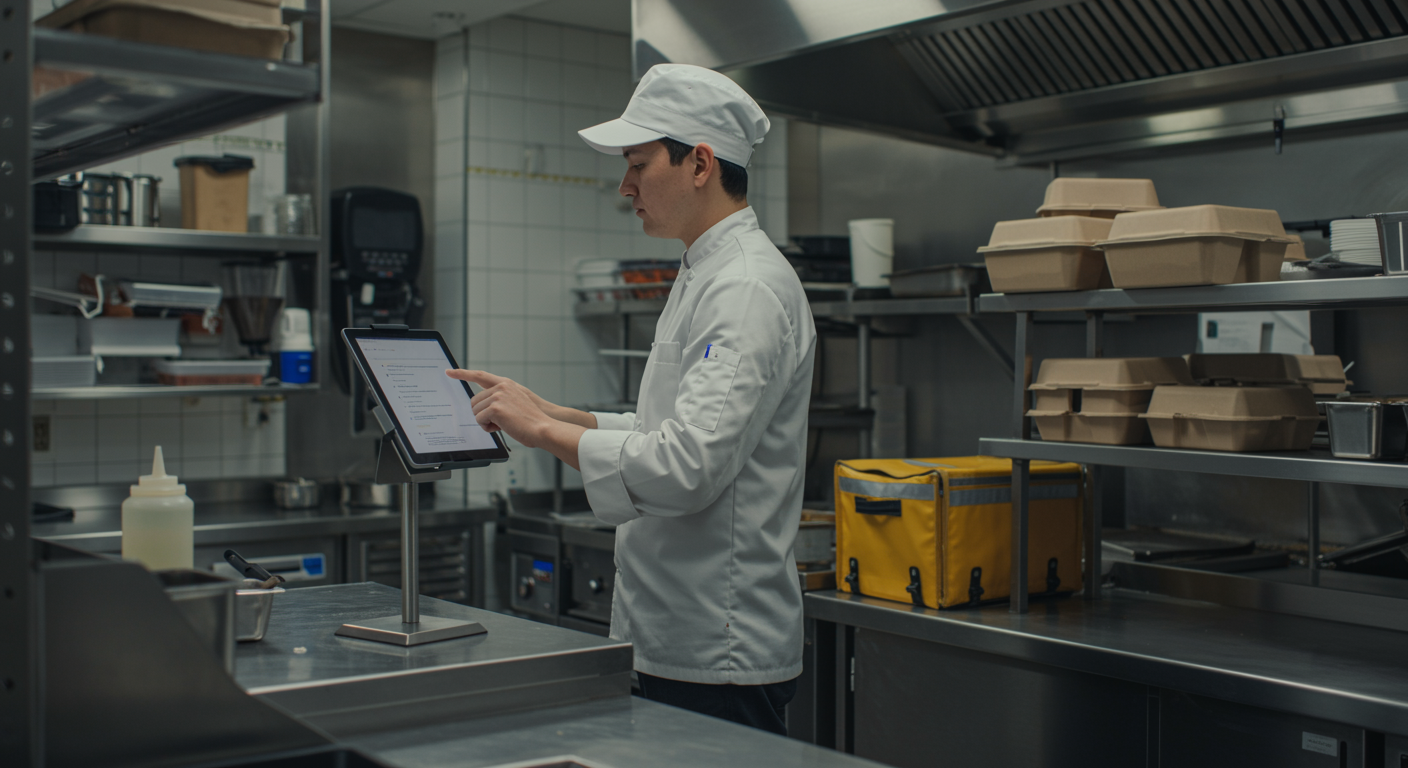
Trouble starts when three riders wait at the door while staff juggle multiple tablets from Uber Eats, DoorDash, and Menulog, which stretches ticket times and invites avoidable mistakes. Teams call this chaos “tablet hell,” where orders print twice, modifiers are missed, or tickets slip through the cracks during dinner rush. A unified POS that pulls delivery platforms into a single screen can cut order handling time by up to 30%, which also reduces manual keying errors and late dockets.
Best Solutions for Multi-Platform Integration
Choosing the right software is the most important decision for a dark kitchen’s workflow. Simple aggregators clear counter space, but a full POS ecosystem gives you the data backbone to grow multiple brands without adding too much daily stress.
| Eats365 (Full POS Ecosystem) | Deliverect (Integration Hub / Middleware) | Generic Aggregator (Tablet-based Middleware) | |
|---|---|---|---|
| Platform Integration | Menu sync, real-time order management, GrabFood support | Central hub, 1,000+ integrations (Uber Eats, DoorDash) | Single-stream order consolidation, tablet-based |
| System Depth | Full Cloud POS: inventory, payments, Xero | Middleware: standardises orders, APIs | Order piping to POS/printer, minimal BOH features |
| Scalability & Virtual Brands | Modular scaling, add virtual brands via iPad | Designed for multi-location scaling, central menu mgmt | Single-device storefronts; limited reporting |
| Inventory & Stock Management | Item-level inventory, online stocktake, adjustment reports | Real-time stock via POS/ERP integration | Varies by provider; basic menu sync or physical stock tracking |
| Order Efficiency & Errors | KDS, mPOS, automated online-to-offline flow | Cuts prep time, Snooze capacity control | Consolidates screens to reduce transcription errors |
| Cost & Pricing Model | From ~$59/month; modular pay-as-you-grow | Location/scale-based subscriptions + setup | Varied (e.g., ~$99/month or per-transaction) |
Eats365
Eats365 provides a modular, all-in-one POS ecosystem built to meet the high-volume needs of modern dark kitchens.
-
Integration Approach: It moves beyond simple order piping by offering seamless delivery app integration and real-time menu syncing that connects directly to your kitchen.
-
System Capabilities: The platform acts as a complete cloud-based commerce engine, with internal inventory tracking, automated accounting through Xero, and detailed backend reporting.
-
Scalability & Hardware: Its "à la carte" modular design lets you add virtual brands or new modules via iPad without needing expensive proprietary hardware.
-
Operational Impact: By consolidating orders into one interface, it eliminates "tablet hell" and uses real-time inventory updates to reduce the frustration of out-of-stock cancellations.
“When we planned to open new stores for Lung Dim Sum, Eats365 POS delivered perfectly.”
This system suits owners who want to manage everything—from menu pricing to stock levels—across platforms from a single source of truth.
Deliverect
Deliverect acts as a specialist integration hub that connects many third-party services into your existing workflow.
-
Integration Approach: It bridges delivery platforms and your POS, with over 1,000 integrations globally, including DoorDash and Uber Eats.
-
System Capabilities: Primarily middleware, it offers tools like "Pulse" for marketing and "Dispatch" for last-mile delivery fulfillment.
-
Scalability & Hardware: The software is built to scale multi-location brands effortlessly by managing complex menus and promotions from a central dashboard.
-
Operational Impact: Their system reaches a 99.95% order injection rate, which cuts manual entry errors and can reduce order prep time by up to 25%.
Deliverect is a strong pick for kitchens that already have a preferred POS but need to tidy up a messy delivery setup.
Generic Tablet-Based Aggregators
These entry-level aggregators tackle the immediate problem of too many devices on the prep table.
-
Integration Approach: They usually consolidate marketplace orders onto a single tablet to simplify intake.
-
System Capabilities: Most act as "order pipes" that send data directly to a POS or printer, focusing on order reception rather than deep back-of-house control.
-
Scalability & Hardware: They help eliminate the clutter of multiple tablets, but adding virtual brands can still be limited by basic reporting and inventory features.
-
Operational Impact: These tools reduce manual transcription errors reducing manual transcription errors, though they often need manual checks to keep menus updated across marketplaces.
These suit smaller startups or single-brand kitchens that need a low-cost way to get organised quickly.
Based on the comprehensive researcher output provided, the following table defines the key brands and compares them across critical operational dimensions for the Australian dark kitchen and restaurant market.
How Smart Software Improves Cloud Kitchen Profit
Faster order processing and fewer errors
Consolidating Uber Eats, DoorDash and Menulog into one queue reduces device juggling, cuts ticket handling times by as much as ~30%, and lowers manual entry mistakes that create refunds and wasted prep.
Automated inventory and fewer “86” moments
Recipe-linked inventory deducts ingredients on accepted orders, triggers low-stock alerts and reduces out-of-stock cancellations, protecting revenue and improving customer experience during peak periods.
Centralised menu control and consistent pricing
Push price, description and availability updates once to all sales channels; this cuts admin time, reduces pricing errors and accelerates menu experiments across virtual brands.
Kitchen Display Systems for smoother throughput
KDS replace printers to route dockets to stations, batch identical SKUs and enforce prep SLAs—helping teams hit consistent ticket times and maintain throughput during service spikes.
Smarter rostering and labour efficiency
Order consolidation and forecasting let managers schedule to predicted peaks, monitor orders per labour hour, reduce overtime, and react before service breakdowns occur. Smarter rostering protects margin and improves service reliability.
As you plan a roadmap, start with a baseline of orders and platforms, choose between an all-in-one ecosystem like Eats365 or an aggregator model, map hardware and KDS needs, then run a focused two- to four-week pilot. Refine the pilot with analytics, because the local ghost kitchen sector is growing quickly, with strong delivery demand in major cities according to Australian meal delivery forecasts.
General FAQs
Q: What are the key features of cloud kitchen management software that can help me streamline my dark kitchen operations?
Key features to look for include: unified POS/order consolidation to eliminate "tablet hell"; real-time menu syncing with delivery apps; integrated inventory (recipe-linked stock, online stocktake, low‑stock alerts and inventory adjustment reports); Kitchen Display Systems with ticket routing and batching; centralised menu and price management; backend reporting and dashboards (profitability by brand/SKU); integrated payments and automated accounting (e.g. Xero); modular, scalable deployment (iPad support, add virtual brands) and support for pilot testing and analytics.
Q: Which cloud kitchen management solutions offer the best multi-platform order integration for delivery businesses in Australia?
Deliverect is the specialist integration hub (1000+ integrations, explicit support for Uber Eats and DoorDash and AU multi‑channel strategies). Eats365 is a full POS ecosystem offering seamless delivery‑app integration and real‑time menu syncing (supports GrabFood; AU‑specific links to Menulog/Uber Eats aren’t explicitly detailed). Generic tablet‑based aggregators work for entry‑level consolidation but have limited back‑of‑house depth.
Q: How can cloud kitchen management software improve inventory tracking and reduce food waste for ghost kitchens?
By linking recipes to stock items so each accepted order automatically reduces ingredient quantities, running online stocktakes and inventory adjustment reports, and sending low‑stock alerts before peaks. Combining supplier lead‑time mapping and forecasting reduces overordering and out‑of-stock cancellations; real‑time stock updates sync across marketplaces to prevent selling unavailable dishes; dashboards let you monitor SKU profitability and adjust menus or promotions to cut waste.
Q: How much does cloud kitchen management software typically cost for a small to medium-sized dark kitchen in Australia?
Typical Australian ranges: basic POS/order aggregation and simple reports cost around AUD 100–500/month for small single‑site setups; multi‑brand or multi‑site groups commonly pay AUD 500–1,500/month; enterprise ecosystems cost AUD 1,500+/month. Upfront hardware/setup for a lean site is usually AUD 2,000–10,000, and small start‑ups should budget around AUD 2,000–10,000 upfront plus AUD 300–1,000/month for software/services.
Q: Does Eats365's cloud kitchen management software integrate with major food delivery platforms like Uber Eats and Deliveroo?
Eats365 offers seamless delivery‑app integration and real‑time menu syncing and supports platforms such as GrabFood; however, direct AU‑specific links to Menulog/Uber Eats are not explicitly detailed in the current documentation.
Q: What are the top cloud kitchen management software options that can help me scale my virtual restaurant brand efficiently?
Top options from the article are Eats365 and Deliverect: Eats365 is a full, modular cloud POS ecosystem built to scale virtual brands via an à la carte approach, containerised apps and centralised menu/inventory/analytics; Deliverect is ideal as a middleware integration hub to centralise orders and menus across many marketplaces while keeping your existing POS. Generic tablet aggregators are suitable for very small startups but offer limited scalability and reporting.