Cafe Loyalty Program Singapore: Run Rewards at the POS
Struggling with slow queues and lost stamp cards? Discover how to run a seamless cafe loyalty program at your POS, covering frictionless sign-ups, reward models, and PDPA compliance.
 22 Oct 2026

 Eats365
Contents
Which cafe loyalty program fits?
For most independent cafes and small chains in Singapore, the best loyalty model depends on visit frequency and counter workload. Digital points or stamps suit frequent, lower-value visits. Stored-value credit suits customers who prepay, while tiered or paid membership works only when the benefit is clear and ongoing.
Paper stamp cards are simple to start, but they leave two gaps. Customers may lose them, and the cafe has no record of who comes back or when visits stop.
Eats365 offers points-based, tiered and prepaid options through its Eats365 POS, so each cafe can match the model to its operation.
| Loyalty model | Best-fit cafe type | Customer experience | Counter effort | Operational considerations |
|---|---|---|---|---|
| Digital points or stamps | Frequent, lower-value visits, such as kopi-style cafes and takeaway counters | Easy to follow, for example 1 stamp per drink or 1 point per SGD 1 spent | Low: staff look up the member at checkout | Choose per-visit or per-spend earning. Per-visit suits uniform drinks, while per-spend suits varied orders. |
| Stored-value credit | Regulars who prepay, such as office-area cafes at lunch | Pay from a prepaid balance at checkout | Medium: staff check and deduct the balance on each order | Track every balance. Agree refund terms in advance and tell customers. |
| Tiered or paid membership | Cafes with dedicated regulars and a clear perk for each tier | Visible benefits, such as extra points or member-only discounts | High: staff must know tier rules and eligibility | Benefits must stay clear and ongoing. This model adds more rules to manage than a stamp or points scheme. |
New cafes often start with one model and add tiers later, once staff can apply the basic rules at checkout without delays.
How can cafe customers join fast?
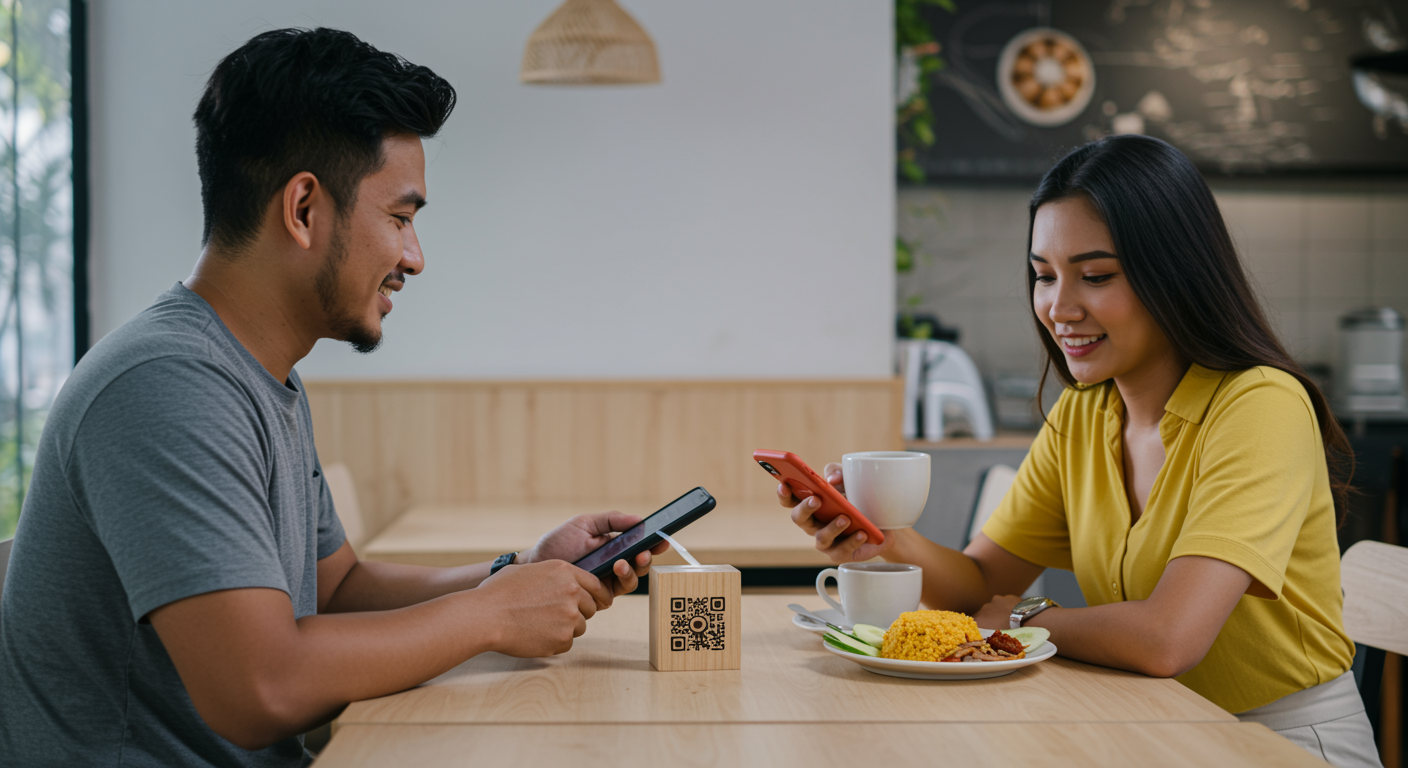
A practical goal for a Singapore morning queue is to finish customer sign-up in about 10 seconds, without an app download. Cafes can choose from four routes: phone number, receipt QR code, WhatsApp, or Apple or Google Wallet card. The best route depends on the loyalty setup, so test each one at the counter before launch.
| Sign-up route | Advantage | Drawback |
|---|---|---|
| Phone number at POS | Staff can key in the number quickly, and no customer device is needed. | Some customers decline to share a phone number, and typing errors can slow the queue. |
| Receipt QR code | Customers scan the code with their own phone, so staff do not type anything. | The code must be visible at the counter, and customers in a rush may skip it. |
| Many customers already use WhatsApp daily, so the route feels familiar. | Customers must be willing to message the cafe, and the route needs a set-up step. | |
| Apple or Google Wallet card | The card sits in the phone's wallet, so there is no app to install. | It works only on supported phones, so staff need a backup route. |
The Pixalink listing on Eats365 Singapore describes phone-number identification at the Eats365 POS and WhatsApp access without a separate loyalty app. Customers who prefer not to share a phone number should be able to decline without slowing checkout.
How should POS loyalty work?
Cafe staff run a loyalty program from the Eats365 POS order-taking screen. They add the member to the order, apply points or member benefits, deduct stored credit when requested, and confirm the updated balance before payment. No second tablet is needed.
-
Identify the member. Tap Add Customer, search by phone number or name, then tap Add to order (add a member to an order).
-
Confirm the eligible order. Check that the tender type is one set to earn points on the member's plan.
-
Accrue points or apply the member benefit. Points follow the earning rules in the Eats365 membership plan setup, which requires a Loyalty Program license.
-
Redeem points or deduct credit. Apply points only when the customer asks. For credit, the member's balance appears on the payment page after tapping Pay.
-
Confirm the updated balance. Check the Point Balance or Credit in the member's Overview tab before the customer leaves.
Staff checklist
-
Ask for the phone number at the start of the order.
-
Confirm the member's plan and loyalty discount name appear on the order.
-
Redeem points or credit only when the customer requests it.
-
Read the remaining balance back to the customer before payment.
Clear staff prompts and consistent rules reduce missed accruals and checkout confusion. Test the full workflow on the Eats365 POS before launch, covering one points order, one redemption, and one credit payment.
What does PDPA mean for loyalty?
Collecting member details and sending marketing messages are separate steps under Singapore's rules. Before a cafe contacts members with promotions, it should check the Do Not Call (DNC) requirements in the official PDPC guide to Singapore's DNC provisions. This section gives a general overview only and is not legal advice.
-
Collecting member information: Ask only for the details your rewards program needs, and tell members why you collect them.
-
Using member data: Use the details for the purpose members agreed to, with consent that is clear and appropriate.
-
Sending marketing messages: Check DNC requirements for Singapore telephone numbers before each campaign.
-
Joining a program: Membership does not automatically permit every marketing message. Treat each message type as a separate check.
-
Current requirements: Follow the PDPC's official guidance, and re-check it before you launch.
Which loyalty metrics should cafes track?
Cafes should track four loyalty measures: member repeat-visit rate, average member spend compared with non-member spend, stored-credit balance, and the number of inactive members. Each measure answers a specific question about whether members return, what they spend, and who has stopped visiting. Review these figures on a fixed schedule and compare them with the cafe's own pre-launch numbers.
| Measure | Plain-English definition | Operational question it helps answer |
|---|---|---|
| Member repeat-visit rate | Share of members who visit again within the review period | Are members returning, and do the stamp or points rules give them a reason to come back? |
| Average member spend vs non-member spend | Average bill value of member orders compared with non-member orders in the same period (in SGD) | Do members spend differently, or is the reward mainly changing where they order? |
| Stored-credit balance | Total unused prepaid credit held by members at the end of the period | How much credit is still unused, and does the balance match the refund terms the cafe set in advance? Monitor it as a balance, not as proof that the program works. |
| Number of inactive members | Members with no visit within an inactivity window the cafe sets | Which members have stopped visiting and may need a follow-up? |
Eats365's guest retention solution lists data analytics for understanding customer behaviour. Review the four measures on the same schedule, such as monthly, and compare each one with your figures from before the program launched.
Should cafes build or integrate loyalty?
Cafes that want points, store credit and member discounts inside the POS usually suit built-in Eats365 Membership, which requires a Loyalty Program licence. Cafes that need a connected CRM workflow, such as a different sign-up or messaging route, may suit an integration with a CRM partner. The right fit depends on your sign-up routes and messaging needs.
| Option | Best fit | Sign-up route | Operating approach | Watch-outs |
|---|---|---|---|---|
| Built-in membership plan setup (Tier Plan or Premium Plan) | Cafes that want membership tools within the Eats365 POS ecosystem; see cafe & coffee shop solutions | Online joining through the restaurant website or Eats365 User App; Tier Plans can also allow direct joining | Plans, points, store credit and member discounts are set in the Merchant Portal CRM (Eats365 guest retention) | Requires a Loyalty Program licence; Tier Plans need upgrade and extension rules |
| Pixalink integration | Cafes that need a connected CRM workflow | Phone number at the POS and WhatsApp access, with no separate loyalty app | Transaction data syncs with the partner's loyalty engine | Confirm the partner's features and terms before you commit |
| Other CRM partners on the Eats365 Singapore apps listing | Cafes comparing other connected tools | Varies by partner | Varies by partner | Review each partner's scope and terms separately |
Building a Practical Loyalty Strategy for Your Cafe
A successful cafe loyalty program balances customer convenience, queue speed, and regulatory obligations like Singapore’s PDPA. Whether implementing digital stamps, stored credit, or multi-tier perks, the priority is keeping counter workflows fast and manageable for staff during peak hours. As you refine your retention strategy, consider evaluating how modern restaurant platforms—including built-in POS tools like Eats365 alongside specialized CRM integrations—can best align with your cafe's daily service style.
Cafe Loyalty Program Singapore FAQs
Q: Are digital stamp cards better than physical coffee loyalty cards for small cafes in Singapore?
Yes, digital stamp cards eliminate common issues with paper cards, such as customers losing them or staff having no visibility into customer return rates. Unlike paper cards, a digital system linked to your POS automatically records customer visit frequency, spend history, and inactive members. This allows cafe owners to see exactly who comes back without adding counter clutter or slowing down takeaway lines.
Q: Can a cafe POS system track customer rewards without customers downloading an app?
Yes, cafes can track rewards without requiring customers to download an app by identifying members via their mobile phone number at the POS. Customers can also join and track their perks using receipt QR codes, WhatsApp integrations, or Apple and Google Wallet passes. This approach keeps sign-up times under 10 seconds, preventing counter delays during peak morning rush hours.
Q: What are the operational benefits of running a loyalty program directly on the POS?
Running loyalty directly on the POS eliminates the need for a secondary tablet or standalone hardware at the counter. Staff can look up members, apply discounts, accrue points, and deduct prepaid balances directly from the main order-taking screen. Consolidating rewards into the standard checkout workflow prevents missed points accruals, speeds up queue management, and avoids manual entry errors during busy shifts.
Q: Does signing up for a cafe loyalty program allow sending marketing messages in Singapore?
No, joining a loyalty program does not automatically give a cafe permission to send promotional messages under Singapore's Personal Data Protection Act (PDPA). Collecting phone numbers for rewards tracking and sending marketing communications are separate actions. Cafes must obtain distinct consent and check the Do Not Call (DNC) Registry requirements before contacting members with promotional offers or SMS campaigns.
Q: When should a cafe use a stored-value loyalty model instead of digital stamps?
A stored-value credit model works best for cafes with frequent regulars who prefer prepaying, such as office-area venues serving lunchtime crowds. While stamps suit uniform, single-drink purchases, prepaid credit encourages repeat visits and larger upfront commitments. Operators using stored credit must track unused balances carefully, confirm remaining amounts before payment, and establish clear refund terms for customers in advance.