Chowbus vs MenuSifu vs Eats365: Chinese Restaurant POS Battle 2026
Trying to pick the right POS for a Chinese restaurant can feel overwhelming. This comparison looks at Chowbus, MenuSifu, and Eats365 and explains how each handles the real day-to-day challenges Chinese eateries face in 2026.
 13 Feb 2026

 Eats365
Contents
2026 Trend of Chinese Smart Dining in US
-
Shift to Digital Payments: Moving from "cash only" to card terminals and mobile wallets.
-
Contactless Safety: Promoting cashless operations to reduce theft risk.
-
Suburban Tech Demand: Younger diners in hubs like Flushing expect QR ordering and loyalty apps.
-
Automation for Labor Shortage: Using self order kiosk to manage staff shortages.
Historic Chinatowns in San Francisco and New York face higher rents, rising labor costs, and shifting tourism. Many merchants are moving away from handwritten tickets and “cash only” signs toward card terminals and digital wallets alongside full POS systems.
You see the same pattern in nearby districts like Oakland Chinatown, where small restaurants encourage card payments to reduce safety risks and lower the need for extra staff instead of keeping large amounts of cash on site.
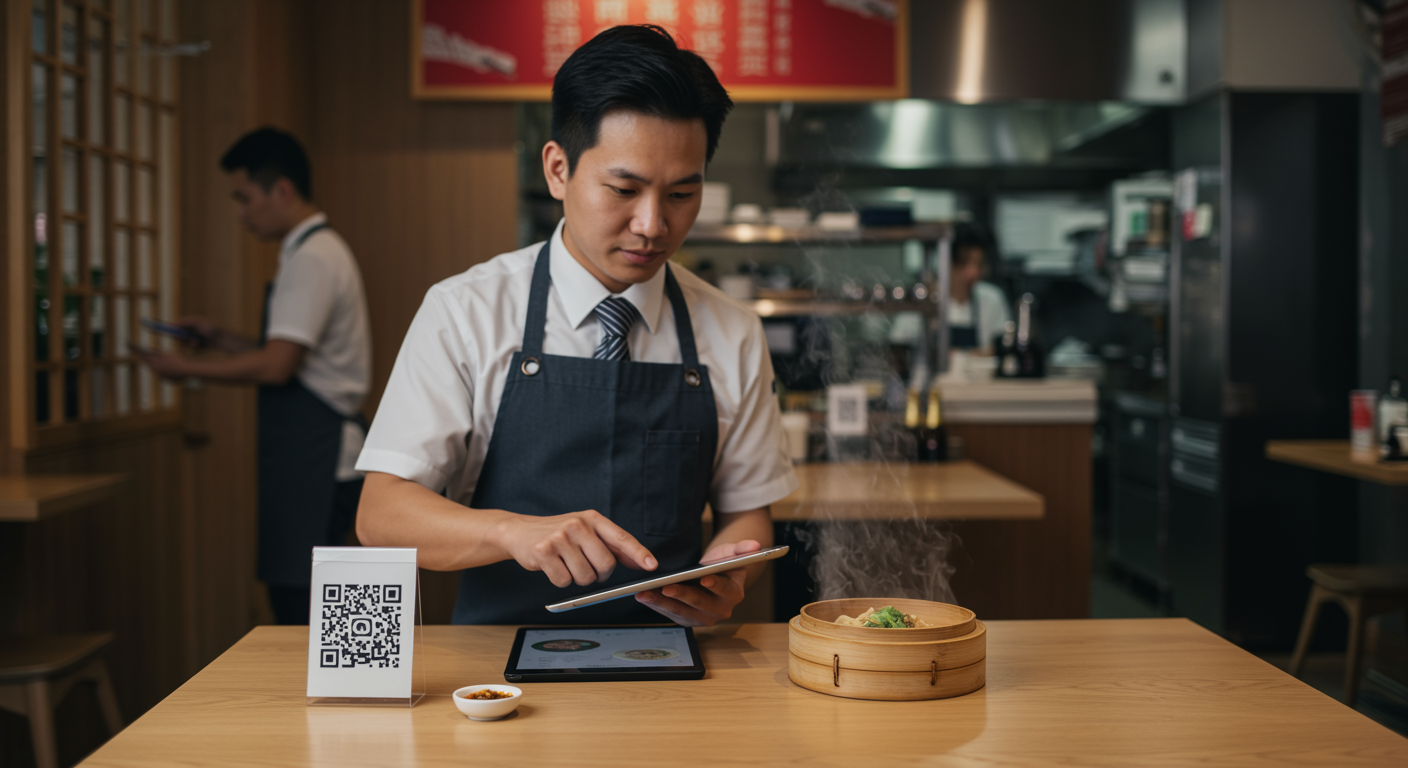
At the same time, newer suburban hubs such as Flushing and the San Gabriel Valley draw younger diners who expect QR menus, mobile wallets, and digital loyalty programs on their own phones, often requiring specialized Chinese payment processing support.
Operators also struggle to hire skilled wok and dim sum chefs as older masters retire and fewer young cooks train for those roles, adding to the labor shortage pressures. In 2026, many owners use automation, QR self-ordering, and BYOD tools to reduce pressure on limited bilingual servers.
3 Reasons Rigid All-in-One Systems Fail
Many Chinese restaurants choose Chowbus or MenuSifu because the vendor ships a full box of hardware. These POS 'walled gardens' often tie printers, tablets, and payment devices to one brand and contract. However, this approach often leads to frustration:
-
Feature Bloat: You end up paying for a suite of modules your team never uses.
-
Closed Ecosystems: Integration with external accounting or HR software is difficult or impossible.
-
Scaling Issues: Growing from a takeout window to a full-service restaurant often requires a complete hardware overhaul.
All‑in‑one menus usually include extra software modules your team never opens. One vendor admits that POS software has become bloated, and operators complain about paying for 500 features while using only a few every day.
For a busy Chinese takeout that runs WeChat promotions, feature bloat slows staff training and menu edits. You need fast item changes, combo buttons, and Chinese‑language receipts, not an oversized CRM package nobody uses.
Closed systems also make accounting harder when your bookkeeper asks for real‑time sales in QuickBooks or payroll data for Gusto. Firms that help restaurants integrate POS and accounting say integration cuts manual entry errors and speeds reporting.
US operators plan more tech for payroll, scheduling, and inventory, according to the Restaurant Technology Report 2024. When a POS forces you into its own HR or accounting tools, you lose choice and often pay higher fees.
Scaling causes the biggest headaches. A small Chinatown takeout may only need two iPads and a cash drawer. If you expand into a full‑service hot pot with tableside tablets and shared checks, a scalable POS system should grow without a full rip‑and‑replace.
Modular platforms such as Eats365 let you add self‑order kiosks, QR ordering, or kitchen screens when needed while keeping existing iPads. A RestaurantOwner.com survey found almost 30% of restaurateurs want to change POS, often because the current system doesn’t fit.
When you compare Chowbus, MenuSifu, and Eats365, check that your POS can:
-
Turn off paid modules and features your team does not use, so you stop wasting subscription dollars each month.
-
Connect to existing accounting, payroll, HR, delivery, and marketing tools through open integrations instead of only proprietary add‑ons.
-
Scale from a single counter‑service shop to multi‑location hot pot or dim sum without buying all‑new terminals.
Here is the comparison summary of how Chowbus, MenuSifu, and Eats365 manage complex Chinese restaurant formats like All-You-Can-Eat (AYCE) and Hot Pot.
Top-Recommended Chinese Restaurant POS Systems
| Dimension | Eats365 | MenuSifu | Chowbus |
|---|---|---|---|
|
AYCE & Specialized Workflow |
Supports tier-based ordering (restricting items to service levels), time-limit tracking, and smart throttling to reduce food waste and manage velocity. |
Offers flexible menu management and upselling tools. Lacks explicit details on time-enforced limits compared to Chowbus, focusing more on smart combos. |
Includes dining time limits, round tracking, and per-guest limits on premium items like Wagyu steak. |
|
KDS Integration |
Features online-offline syncing for connectivity issues and timer alerts for aging orders. Integrates with mPOS and PhotoMenu modules. |
Integrating over 50 delivery platforms directly into the kitchen. |
Orders from online/kiosks go directly to KDS to reduce errors. Bundled systems eliminate integration fees. |
|
Inventory & API |
Directly syncs with MarketMan (ERP), Xero (Accounting), and StockTake Online for daily sales and menu inventory management. |
Tailored with real-time updates. Integrates with Otter and Deliverect for data aggregation. |
Focuses on ingredient limits to control costs. Offers multi-location tracking and barcode printing. |
|
BYOD & Scan-to-Order |
Supports complex rules like pay-at-counter vs. pay-later via mobile devices. |
Supports BYOD capabilities and self-service kiosks, though specific sync technicals are less detailed than competitors. |
Supports advanced tablet ordering and QR-based systems to eliminate paper menus and reduce labor costs. |
|
Pricing & Fees |
Modular structure. |
Incentive-based. |
Transparent/Tiered. Processing: 2.6% + 15¢ (card-present). |
Eats365
Eats365 uses a modular architecture so restaurants add only the software pieces they need rather than buying unneeded hardware. Its AYCE features include smart throttling and behavioral analytics to cut food waste and spot unusual ordering patterns. The platform supports BYOD (Scan-to-Order) capabilities, letting guests order from their own phones while syncing immediately with the kitchen. Eats365 follows a clear SaaS model starting at $59/month, so you pay only for what you use. This fits operators who want a tech-forward, future-ready system that connects easily with ERPs like MarketMan or Xero.
MenuSifu
MenuSifu uses a 'Legacy Bundle' approach that combines hardware, 24/7 support, and on-site installation so new restaurants can get running quickly. Its Smart Inventory solution works well for seafood operations, with real-time tracking and price adjustments tied to seasonal quality. The system includes a fully integrated KDS that routes orders to specific stations, which helps during a busy Dim Sum or dinner rush. They sometimes offer a special grant program with $0 upfront costs, though long-term fees can include per-order charges or specific processing rates. Choose MenuSifu if you prefer a traditional, hands-on service model with fixed hardware terminals.
Chowbus
Chowbus offers a POS tailored for the high-volume flow of AYCE and Hot Pot restaurants. Its main feature is a strong tablet ordering system that shows a countdown timer to help manage dining limits and speed table turnover. To protect margins, managers can restrict premium items, such as limiting Wagyu beef to two servings per person. The system provides a comprehensive API for multi-location tracking and warehouse visibility, but pricing often includes bundled hardware fees and fixed transaction rates that may be higher than modular SaaS options. This setup suits owners who want a dedicated tablet system built around the AYCE workflow.
Elevating Your Restaurant's Future
The US restaurant market keeps changing, and Chinese F&B owners need a POS that fits current operations and future plans. Eats365 offers a modular cloud-based POS that helps you manage QR code ordering, kitchen flow, and multi‑location reporting while keeping costs tied to the features you actually use. Want to see if Eats365 suits your restaurant? Send us an inquiry today!
General FAQs
Q: What are the top POS systems specifically designed for Chinese restaurants in 2025?
A: Chowbus, MenuSifu, and Eats365 are the main POS options noted for Chinese restaurants in 2025.
Q: How do Chowbus, MenuSifu, and Eats365 compare for managing hot pot and buffet restaurant operations?
A: Chowbus focuses on AYCE/hot pot workflows with tablet ordering, countdown timers, per-guest limits, and multi-location APIs but often bundles hardware and transaction fees. MenuSifu provides fixed terminals with station-specific KDS routing, strong smart inventory for seafood, and a high-touch Legacy Bundle including on-site installation. Eats365 uses a modular SaaS architecture with BYOD/scan-to-order, smart throttling, time-limit tracking, and straightforward monthly pricing so you can scale without replacing existing hardware.
Q: What features make Eats365 unique for Chinese restaurant point of sale management?
A: Eats365’s modular architecture, BYOD (Scan-to-Order) capabilities, smart throttling and behavioral analytics for AYCE, tier-based ordering and time-limit tracking, real-time online/offline syncing and timer alerts, plus direct integrations with MarketMan, Xero and StockTake Online are key differentiators.
Q: Which restaurant POS system has the best inventory tracking for Chinese restaurant ingredients?
A: MenuSifu’s Smart Inventory is strong for seafood and high-cost items with real-time updates; Eats365 offers ERP-level syncs (MarketMan, Xero, StockTake Online) for daily sales and menu inventory workflows; Chowbus provides ingredient limits and multi-location tracking. Pick based on whether you value seafood-specialized tracking (MenuSifu) or broad ERP integration (Eats365).
Q: Pros and cons of Chowbus vs MenuSifu for small to medium Chinese restaurants in the US?
A: Chowbus Pros: Advanced AYCE controls (timers, per-guest limits), tablet-focused ordering, APIs for multi-location tracking. Cons: Bundled hardware fees, fixed transaction rates, less modular flexibility. MenuSifu Pros: Legacy Bundle with hardware + 24/7 support and on-site setup, strong Smart Inventory for seafood, $0 upfront grant options. Cons: Possible per-order/processing fees over time, more rigid fixed-terminal model, fewer explicit AYCE time-enforcement details.
Q: How much does a specialized POS system cost for a Chinese restaurant in 2025?
A: Chowbus shows processing around 2.6% + $0.15 (card-present) with software roughly $0–$200+ per terminal; MenuSifu can offer $0 upfront hardware via grant programs but may charge transaction or per-order fees (sometimes ~1% or $1 customer fees); Eats365 basic SaaS plans start at $59/month with additional fees for expansion modules like KDS or BYOD.
Q: Can Eats365 integrate with existing restaurant management tools for Chinese cuisine businesses?
A: Yes. Eats365 syncs with ERPs and accounting/inventory tools such as MarketMan, Xero, and StockTake Online and supports open integrations for external payroll, scheduling, and delivery systems.
Q: What is the most cost-effective POS system for a new Chinese restaurant startup?
A: For low monthly, modular cost and pay-for-what-you-use flexibility, Eats365 (starting at $59/month) tends to be the most cost-effective ongoing choice. For minimal upfront hardware expense, MenuSifu’s $0 upfront grant program can be the most affordable initial option. Chowbus may have higher bundled hardware and processing costs.