What Is Menu Engineering? Your Aussie Restaurant's Profit Game-Changer
Menu engineering is a strategic, data-driven methodology that combines analytical rigour with psychological insights to optimise restaurant menu profitability and performance. It is "the process of analysing menu data and using the results to optimise the profitability and popularity of menu items." This analytical approach turns a simple list of dishes into a strategic tool that can materially improve a venue’s bottom line.
 16 Oct 2025

 Eats365
Contents
- Why Australian Restaurants Need Menu Engineering Now
- Introducing the Four-Quadrant System for Menu Engineering
- Phase 1: Data Collection & Analysis
- Phase 2: Strategic Decision-Making Framework
- Phase 3: Seasonal Adjustments for Australian Dining Patterns
- Phase 4: Integration with Digital Menu Platforms
- Technologies that Make Menu Engineering Easier in Your Restaurant
- Elevate Your Restaurant's Profitability with Smart Solutions
- FAQs about Menu Engineering for Australian Restaurants
Why Australian Restaurants Need Menu Engineering Now
The Australian restaurant sector is operating under intense financial pressure. The Australian Financial Review shows operators make an average net profit of just 2% on every dollar diners spend. That leaves almost no room for error, little inefficiency or a few poor menu decisions can quickly wipe out profit.
Worse, industry churn is rising. Peiso reports an 8.2% failure rate for Australian restaurants in 2024, 1,667 businesses closed, a 50% jump on the year before. By the meanwhile, studies suggest menu engineering can lift profitability by as much as 20%. To give that some context: if you’re running at a 2% net profit today, a 20% relative improvement moves you to 2.4%, a small-looking change that can mean the difference between surviving and folding.
Cornell University research shows restaurants that applied menu engineering methods reported 10% sales increases by promoting higher-margin dishes and shrinking the footprint of low-performers. That kind of lift is exactly what Australian operators need when food costs and supply issues are squeezing margins: as NetSuite notes, 76% of operators saw food costs rise in the last year and 53% removed menu items in response. Menu engineering helps you make those decisions from data, not instinct.
Introducing the Four-Quadrant System for Menu Engineering
The four-quadrant matrix categorises items by profitability and popularity. For accurate results, pull a 30–90 day POS data window showing quantities sold and selling prices.
For example: Thai Wings selling for $6.75 with a portion cost of $1.93 produce a contribution margin of $4.82. Modern POS systems can help automating much of this by reporting Quantity and Profit metrics. Precision matters. If your average contribution margin is $8.50 and your popularity threshold is 10%, any item above those marks is a Star.
| Matrix Category | Profitability Level | Popularity Level | Strategic Priority | Common Australian Examples |
|---|---|---|---|---|
| Stars | High (Above Average) | High (Above 10%) | Maintain & Promote | Chicken Parmigiana, Fish & Chips |
| Plow Horses | Low (Below Average) | High (Above 10%) | Improve Margins | Pasta dishes, Basic burgers |
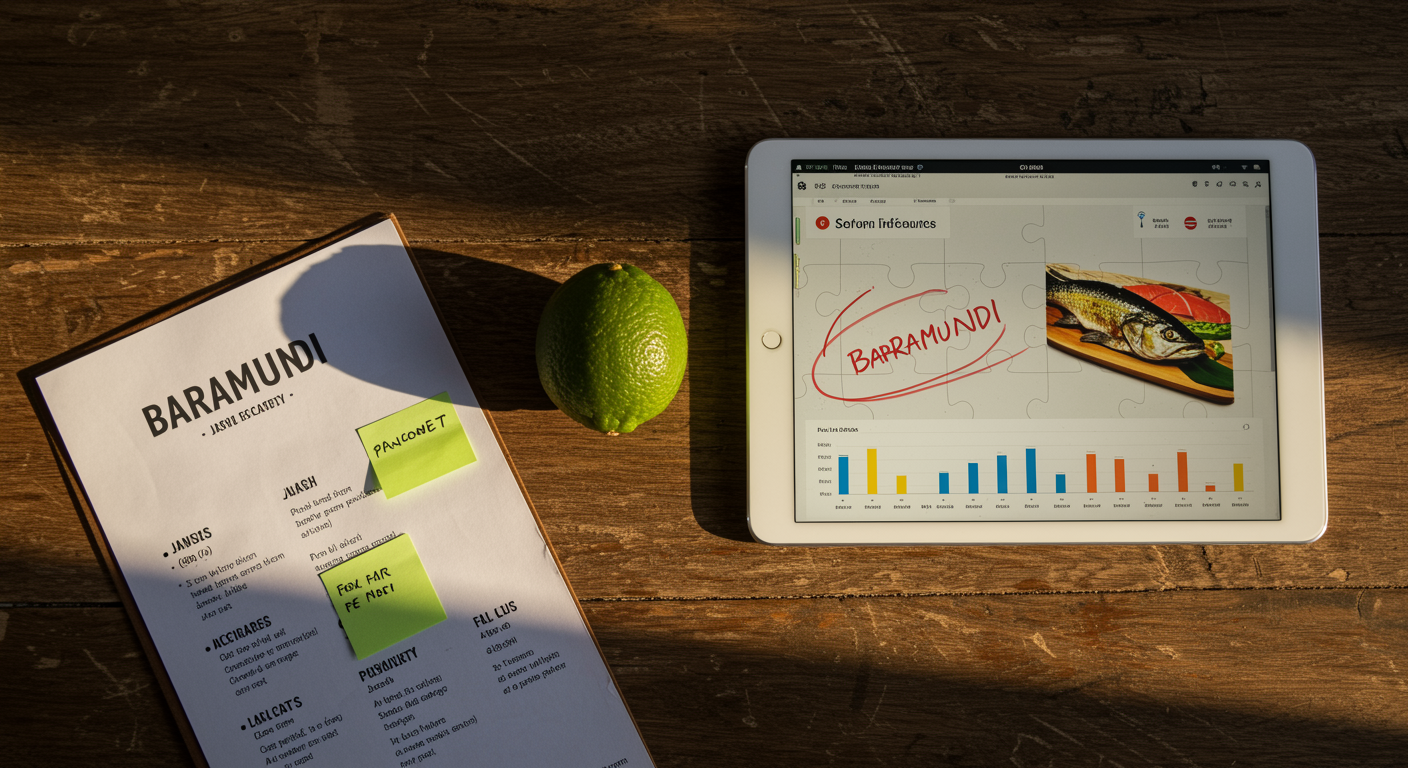
| Puzzles | High (Above Average) | Low (Below 10%) | Boost Awareness | Barramundi, Native ingredient dishes |
| Dogs | Low (Below Average) | Low (Below 10%) | Eliminate or Revamp | Complex fusion dishes, Kids' meals |
Advanced operators layer behavioural insights on top of raw sales data. Combine those insights with your POS data and you’ll make smarter placement and design choices. For Australian restaurants where industry net profit averages near 4.2%, getting the math right can be survival-critical. The matrix can deliver 10–15% profit improvements, but only if you move beyond intuition and treat menu decisions like a regular, data-driven business process.
Implementing menu engineering requires rigorous analysis, clear strategy, and operational follow-through. The roadmap below gives practical steps to make your menu work harder.
Phase 1: Data Collection & Analysis
Start by exporting complete transaction data from your POS. A 30–90 day period is standard.Modern POS platforms help a lot here. You can run sales by reports filtered by quantity and profit on most POS systems nowadays, while some systems that further provide real-time dashboards for sales patterns, peak hours, and margins. The move from manual spreadsheets to live dashboards gives you much faster visibility and response.
Then you should calculate food costs. The standard Australian formula is simple: Price = COGS / Ideal Food Cost Percentage. So a burger that costs $5 to make at a 25% target food cost suggests a $20 menu price.
However, reality is messier. You need strict portion control, batch costing for shared items (think oil and salt), and frequent ingredient price checks. It's suggested to do batch calculations to capture small-cost items. Expect a typical variance of 5% or more between ideal and actual food costs in Australia, due to waste, spoilage, human error, and seasonal price swings. The COGS formula ((Starting Inventory + Purchases) - Ending Inventory) and the Food Cost Percentage ((COGS / Total Food Sales) × 100) are basic, but you must update them regularly.
Phase 2: Strategic Decision-Making Framework
The industry commonly refers to the "4 R's": Retain, Reprice, Replate, Rethink, but you can interpret these to fit your venue and market realities. Research on how to tailor the approach specifically for Australian restaurants is still developing, so apply judgement and test changes.
Stars: Retain & Maximise
Stars are your money-makers. Keep these visible and consistent. Small price increases are usually tolerated because customers value these favourites. Consider promotions that highlight them without overexposing the dish.
Plow Horses: Reprice & Value-Engineer
Plow Horses bring traffic but erode margins. Tactics here are gentle: slight price adjustments, marginal portion tweaks, or low-cost ingredient swaps that don’t change perceived value.
Puzzles: Reposition & Promote
Puzzles are high-margin but low-volume. Ask why they’re unpopular—is placement poor, descriptions weak, or is staff unfamiliar with how to sell them? Reposition them, improve descriptions, and have staff recommend them. Try rotating puzzles as specials to encourage trial.
Dogs: Rethink or Eliminate
Dogs neither sell nor profit. Check if they satisfy a strategic need (a dietary niche, for instance). If not, remove them to simplify operations and reduce waste. Simpler menus often improve speed and quality.
Phase 3: Seasonal Adjustments for Australian Dining Patterns
Australia’s dining patterns swing with seasons, tourism pockets, and local events. Frequent dining habits create volatility, so a single quarterly review may miss important trends. Regional venues may need different strategies from inner-city sites.
We might suggest running menu analyses multiple times a year, and certainly when ingredient prices spike. Fourth recommends frequent reviews, keeping menus responsive to changing costs and customer preferences is a practical necessity in Australia.
Phase 4: Integration with Digital Menu Platforms
Digital menus make testing cheap and fast. Restroworks reports that 20% of digital orders come through restaurant-owned apps with QR ordering. Beyond cost savings, digital platforms enable rapid price updates and personalise recommendations. AI systems can even support time-of-day pricing to protect margins, something static printed menus can’t do. Digital ordering can increase average spend—especially via QR menus—so use digital tools not just for convenience but for measured experimentation.
Technologies that Make Menu Engineering Easier in Your Restaurant
A. POS System
A capable POS is no doubt a central to menu engineering. For Australian restaurants, integrated analytics are essential. The best systems track ingredient usage, update stock after sales, and generate purchase orders automatically—tangibly reducing waste and improving ordering accuracy.
Given the common 5–15% food waste problem, a POS that ties sales to ingredient consumption matters. Some systems can event provide item-level cost vs profit insights, while others offer real-time dashboards that translate data into decisions on pricing, promotions, and inventory.
B. Inventory Software
Integrating POS with inventory management removes a lot of manual work. Automated recipe costing, real-time usage tracking, and automated restock ordering save time and reduce errors, which is critical where labour and food costs can take 30–35% or more of revenue. This gives you fast, accurate inputs for menu pricing and operational choices.
C. Digital Menus & QR Ordering
QR ordering has become mainstream in Australia. Scanova shows about 70% of companies use QR codes, and qrcodesaustralia reports 36.4% of Australians scan at least one QR code per week. Restroworks finds QR orders lift average spend by 25%—partly because customers browse with less pressure and can add extras easily.
If you run your own QR ordering, you retain customer data for personalisation and loyalty, a super advantage over depending only on third-party platforms.
D. AI Tools
AI is reshaping forecasting and dynamic pricing. 65% of Australian restaurants report AI use and nearly all report benefits in productivity and forecasting accuracy. AI models combine historical sales with external factors (weather, events, holidays) to predict demand, cut waste, and indicate which dishes to promote or replace.
Real-time AI also enables time-of-day pricing and elasticity modelling, helping you react to sudden demand shifts or cost spikes—something manual processes can’t match. PizzaExpress saw a 25% improvement in forecasting accuracy after deploying AI tools.
The smartest operators stitch POS, inventory, accounting (MYOB, Xero), payment processors, delivery platforms, and loyalty systems together. Cloud-based POS gives you centralised data, faster deployments, and easier scaling. With Australian hospitality generating over AUD 48 billion in revenue from cafés, restaurants, and takeaway in 2024, competing on efficiency and insight is essential. For menu engineering, look for systems that provide recipe costing, wastage tracking, automated profit calculations, and delivery platform integration. These tools let you optimise pricing, inventory, and promotions holistically, so your menu decisions actually move the profit dial!
Elevate Your Restaurant's Profitability with Smart Solutions
Menu engineering is essential for Australian restaurants facing tight margins. By leveraging data-driven insights, you can transform your menu into a powerful profit driver. Eats365's integrated restaurant POS systems australia provides the analytics needed to understand item performance, optimise pricing, and refine your offerings, helping you navigate the competitive landscape and boost your bottom line. Inquire today to discover how Eats365 can empower your F&B enterprise.
FAQs about Menu Engineering for Australian Restaurants
Q: What is menu engineering and why is it important for restaurants?
A: Menu engineering is a strategic, data-driven process that analyses menu item popularity and profitability to optimise restaurant menus for maximum profit. It helps restaurants make informed pricing, placement, and promotional decisions to boost revenue, reduce waste, and enhance customer experience.
Q: How does menu engineering improve profitability in Australian restaurants?
A: Menu engineering can increase profitability by 10-20% by identifying high-margin 'Star' items to promote and low-performing 'Dog' items to remove or improve. Given the tight average net profit margins around 2% in Australia, even small relative gains can significantly impact survival and growth.
Q: How can Eats365's hospitality pos systems assist in menu engineering?
A: Eats365’s pos experience provides integrated analytics that track sales, food cost, and profit margins per dish in real time. This data helps operators categorize menu items, optimise pricing, and adjust menu design quickly, making the menu engineering process efficient and ongoing rather than occasional.
Q: What are the key steps in implementing menu engineering effectively?
A: Implementing menu engineering involves: 1) collecting and analysing 30–90 days of POS sales and cost data, 2) calculating contribution margins, 3) plotting dishes in a profitability-popularity matrix, 4) making strategy decisions like retaining Stars or removing Dogs, and 5) involving and training staff to execute changes properly.
Q: How does menu design psychology influence menu engineering outcomes?
A: Psychological factors like colour cues (e.g., red to stimulate appetite), strategic placement ('Golden Triangle'), and descriptive language increase customer engagement with high-profit items. Well-designed menus reduce decision fatigue and nudge diners towards more profitable dishes, enhancing menu engineering impact.
Q: Can Eats365 support menu engineering adjustments during seasonal changes?
A: Yes, Eats365’s real-time dashboards and digital menu integrations allow continuous monitoring and rapid adjustments reflecting seasonal trends, ingredient cost fluctuations, and customer preferences, helping restaurants keep their menus profitable and relevant year-round.